Headlight Restoration Cost: What U.S. Drivers Pay in 2026
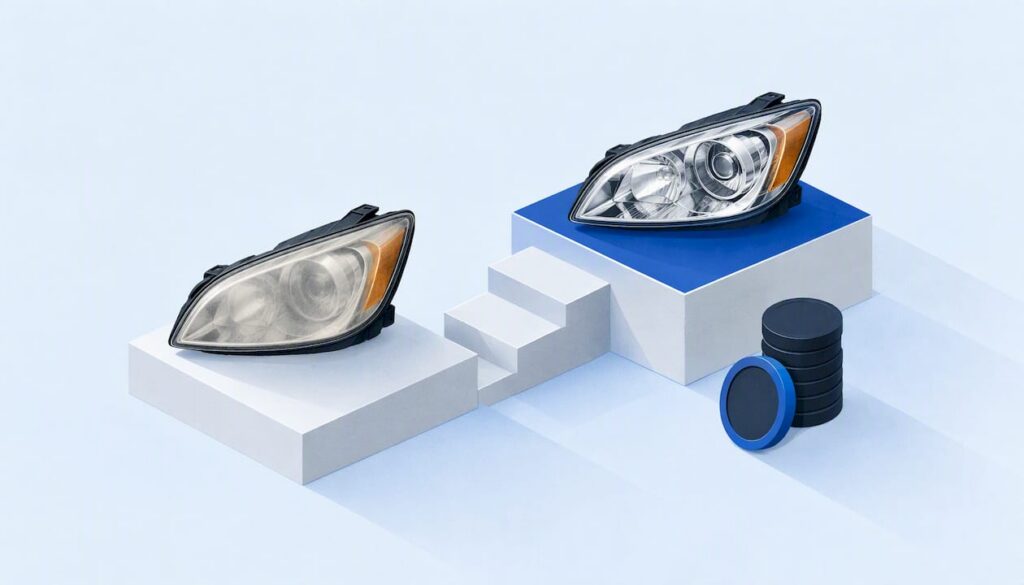
Professional headlight restoration usually costs about $50 to $150, according to Consumer Reports’ roundup of detailer pricing. A do-it-yourself kit costs roughly $10 to $25, according to Consumer Reports’ kit testing. Where you land in that range depends on how oxidized the lenses are, whether the quote covers one lens or the pair, what kind of protective coating goes on at the end, and whether the detailer comes to you.
This guide breaks down those price drivers, compares a pro job with a kit, explains how long results last, and shows when restoration stops making sense and replacement is the better call.
Table of Contents
- What headlight restoration costs in the U.S.
- What makes the price go up or down
- Professional restoration vs. a DIY kit
- How long restored headlights last
- Is it worth restoring cloudy headlights?
- How to choose a detailer for headlight work
- Find a mobile detailer near you
- Frequently asked questions
- Sources
What headlight restoration costs in the U.S.
The numbers below are typical ranges. Your local quote can sit above or below them.
| Option | Typical cost | What you get |
|---|---|---|
| DIY kit | $10 to $25 | Sanding pads or discs, polish, and a protective layer you apply yourself |
| Professional restoration | $50 to $150 | Machine sanding, polishing, and a UV-protective finish, done by a detailer |
| Professional restoration with a premium coating | Often above the basic range | Same prep, plus a longer-lasting sealant or ceramic-type topcoat |
| Replacement (part and labor) | Varies widely by vehicle | New lens or full headlight assembly |
The DIY figure comes from Consumer Reports. The professional range comes from its summary of what detailers charge. Replacement costs are not given a single number here on purpose: a basic halogen assembly on a common sedan and an adaptive LED unit on a luxury SUV are different purchases, and a dealer or parts counter can quote yours exactly.
Per headlight or per pair?
Ask before you book. Many detailers quote a single price for the pair, because both lenses get the same process and the setup time is shared. Others price per lens. A “$60” quote can mean $60 total or $120 for both sides, so confirm the number covers both headlights, the coating, and any travel fee.
What makes the price go up or down
Prices vary because the work varies. These are the factors that most often change a quote.
How oxidized the lenses are
Light yellowing can come off with a moderate polish. Deep, chalky haze needs more aggressive sanding through several grits before the lens is clear. More steps mean more time, so heavily oxidized lenses cost more. Some factory UV coatings are also hard to remove, which adds effort. Consumer Reports’ kit buying guide notes that not every entry-level kit can cut through a hard factory-applied coating.
The protective finish
Sanding strips away the original clear coat that polycarbonate lenses come with. Whatever goes on afterward is what protects the plastic from sun. A basic UV sealant costs less than a durable coating. Since the finish largely decides how soon the haze returns, it is the part of the quote worth asking about. Car and Driver’s kit testing points toward kits with UV and oxidation protection or a ceramic coating for that reason.
Vehicle type and lens size
Larger lenses take longer, and some vehicles have headlight housings that are awkward to tape off or reach. Luxury and specialty vehicles often cost more, partly because the lenses are expensive to replace if a mistake is made, and partly because the job is slower around complex trim.
Where you live
Labor and overhead differ by market. Big metro areas generally cost more than small towns. If you live in a high-cost city, expect quotes toward the upper half of the range. Compare with your own area’s detailing prices, not a national average. For a sense of how a high-cost market shifts pricing in general, see our look at detailing costs in Los Angeles.
Mobile or in-shop
A mobile detailer comes to your home or office, which is convenient but may include a travel or minimum-service charge. A shop may be cheaper for a headlight-only job, but you drop the car off. Headlight work is a good fit for a mobile visit when it is bundled with a wash or interior service, since the detailer is already on site.
Professional restoration vs. a DIY kit
Both can produce clear lenses. The difference is in prep quality, the protective layer, and how long the result holds.
What a kit involves
Kits vary. Some rely on hand sanding and polishing, while others are designed to work with a power drill to speed things up, as the Consumer Reports buying guide describes. Most take under an hour per car once you have masked the paint around the lens. Skipping the masking is the most common mistake: sanding discs and compounds can dull or scratch the paint next to the headlight.
The Consumer Reports kit testing also found that restored hazing typically became noticeable again after about a year, though the same report says kits can be a better value than replacing the headlights. In other words, a kit is a fair option for a mild case, an older vehicle, or a budget you want to protect. Just plan on repeating the job.
What a pro does differently
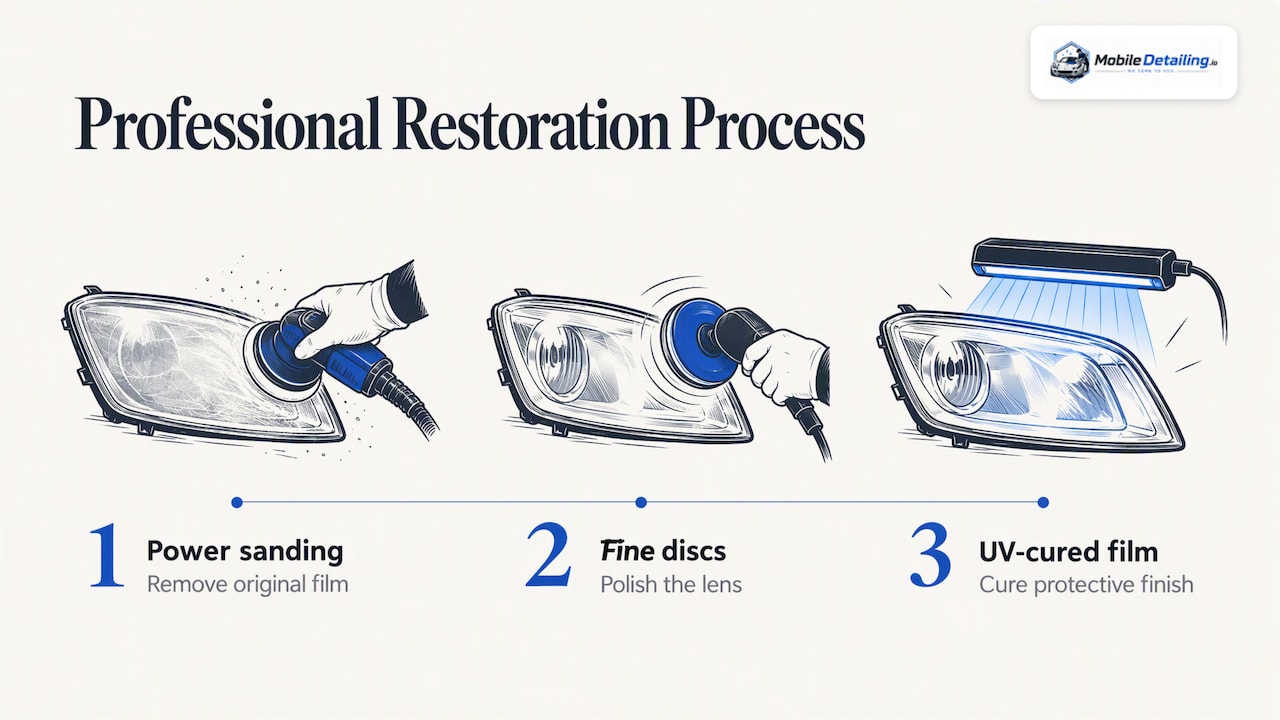
A professional typically uses machine sanding, finer polishing steps, and a dedicated protective finish. The AAA study of headlamp deterioration looked at one professional process that used power sanding to remove the original film, finer discs to polish, and a protective film cured with UV light. The company behind that process claimed the film would last five years. That is a manufacturer claim, and AAA’s report is worth reading for how it describes the testing. Treat any multi-year promise as a best case, since sun exposure, parking habits, and climate all change the outcome.
A detailer’s warranty is the thing to ask about. If a business offers one, get its length and terms in writing. Terms differ by business, and nothing in this article describes any specific provider’s guarantee.
Quick comparison
| Factor | DIY kit | Professional |
|---|---|---|
| Upfront cost | $10 to $25 | $50 to $150 |
| Time from you | About an hour, plus masking | A few minutes to book |
| Prep and sanding | Depends on your technique | Usually machine-assisted |
| Protective finish | Included in kit, quality varies | Often a longer-lasting sealant or coating |
| Best for | Mild haze, older vehicles, tight budgets | Heavy oxidation, newer vehicles, longer-lasting results |
If you would rather skip the work, you can get a local quote and see what detailers near you charge for the pair.
How long restored headlights last
There is no single answer. Restoration removes the damaged surface and replaces the protection, and how long that protection survives depends on the finish used and the conditions the car lives in.
- Kits: Consumer Reports’ testing saw haze return noticeably after around a year.
- Professional jobs: Results generally last longer when a durable UV-protective finish goes on. Claims range widely, and the AAA-studied film was advertised at five years.
- Conditions: A car parked outside in strong sun will fade sooner than one kept in a garage. Hot, sunny regions are harder on lenses than mild ones.
How to keep them clear longer
- Ask the detailer which UV protectant or coating they apply, and what it is rated for.
- Park in shade or a garage when you can.
- Wash the lenses with the rest of the car, and avoid harsh solvents.
- If you chose a kit without a strong UV layer, consider adding a sealant or ceramic-type coating over it. Coatings are a specialty job, so a professional is the safer choice. Our ceramic coating pros and similar specialists in the directory can tell you what they offer for lenses.
If you want a deeper look at methods, see our guide to headlight restoration methods and when to replace.
Is it worth restoring cloudy headlights?
For most drivers with surface haze, yes. The reason is safety as much as looks. Consumer Reports has reported that foggy, yellowed headlamps can cut night visibility substantially, by as much as 80%. Restored lenses let more of the bulb’s light reach the road. They can also help a vehicle pass in places where headlight condition is part of an inspection, though rules differ by state, so check yours.
Compared with new headlights, restoration is also cheap. A $50 to $150 service is a fraction of what many replacement assemblies cost.
When replacement is the better choice
Restoration cannot fix everything. Consider replacement when:
- The lens is cracked or chipped.
- There is persistent moisture or fogging inside the housing, which means a seal has failed.
- The damage goes deeper than surface oxidation, such as pitting or deep scratches that sanding would not remove.
- The bulb or reflector inside has degraded, so polishing the outside will not bring the output back.
On many vehicles the lens is permanently bonded to the housing, so replacing the lens means replacing the whole assembly, as this parts retailer’s explainer notes. Also, kits tend to work on mild oxidation or yellowing and may not help when damage is extensive.
If you are unsure which category your headlights fall into, a detailer can usually tell in a minute by looking at the lens and feeling the surface.
How to choose a detailer for headlight work
Headlight restoration is a small job, so it is easy to treat it casually. A few questions separate a careful result from a rushed one.
- Is the quote for the pair? Get the total in writing, including travel fees.
- What is the process? You want to hear about masking the surrounding paint, multiple sanding grits, polishing, and a UV-protective finish.
- What protects the lens afterward? Ask for the product type and what the detailer expects it to do under your local sun.
- Is there a warranty or a touch-up policy? Ask what it covers and for how long.
- Can they bundle it? Adding headlights to an exterior wash or a full detail can be more convenient, and some businesses price bundles differently. Our guide to paint correction costs shows how to read a quote for exterior work.
Leave wet sanding and any coating application to a trained pro. Doing it wrong can leave uneven haze, scratched paint, or a coating that peels. Sanding slurry and some solvent-based products also call for gloves and ventilation, so follow the label on anything you use.
Find a mobile detailer near you
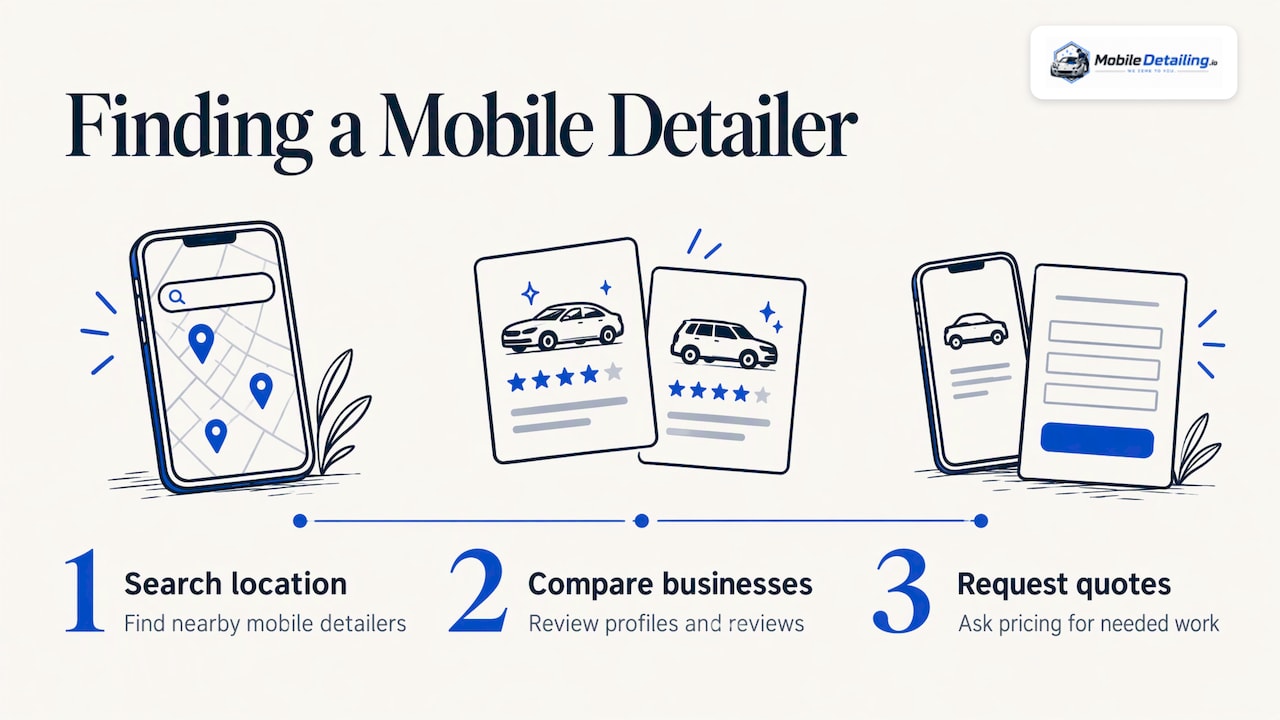
MobileDetailing.io is a nationwide directory where you can search by location, compare local mobile detailing businesses, and send quote requests. It is free for vehicle owners. You can browse detailers by service, read profiles and reviews, and ask for pricing on the work you need, whether that is headlight restoration alongside a full interior detail or an exterior service. Start on the MobileDetailing.io home page or go straight to a local quote request.
Prices on this page are typical ranges from the sources linked, not offers from MobileDetailing.io or any listed business. Each detailer sets its own rates.
Frequently asked questions
How much does headlight restoration cost for a pair?
Most professional jobs run about $50 to $150 for the pair, based on Consumer Reports’ summary of detailer pricing. Heavy oxidation, a premium coating, a luxury vehicle, or a high-cost city can push a quote higher. Confirm whether the number covers both lenses before you book.
Do headlight restoration kits really work?
They can, especially on mild haze or yellowing. Consumer Reports found that kits costing $10 to $25 can improve cloudy lenses, but the clarity often fades again after about a year. They may not work when the damage is deep or the lens is cracked.
Can cloudy headlights be fixed permanently?
Not in a strict sense. Restoration replaces the lens’s lost UV protection, but sun, heat, and road wear keep acting on it. A durable UV coating and shaded parking slow that down. If the lens or housing is damaged beyond the surface, replacement is the lasting fix.
Is it cheaper to restore or replace headlights?
Restoration is usually cheaper when the problem is surface oxidation. Consumer Reports says kits can be a better value than replacement. Replacement becomes necessary for cracks, internal moisture, or damage that goes beyond the outer layer.
Sources
- Consumer Reports: Car Accessories That Improve Safety, Comfort, and Organization
- Consumer Reports: Do Car Headlight Restoration Kits Really Work?
- Consumer Reports: Best Headlight Restoration Kit Buying Guide
- AAA: Headlamp Lens Deterioration
- Car and Driver: Best Headlight Restoration Kits of 2026, Tested
- CarParts.com: Do Headlight Restoration Kits Work?
Recommended
- Headlight Restoration: Cost, Methods and When to Replace
- Interior Detailing Cost: What U.S. Drivers Pay in 2026
- Compare: Price Detailing Services for U.S. Owners & Fleets ($150–$300)
- $500–$2,500+: Paint Correction Cost U.S. Owners Pay and What to Ask
MobileDetailing.io provides general educational information. Products, surfaces and vehicle finishes vary. Follow manufacturer instructions and consult a qualified detailing professional before using abrasive processes or chemical treatments.