Detailers: Avoid Unlimited Liability in Dealership Detailing Contracts

Yes, always use a written dealership detailing contract that names scope, schedule, pricing, insurance, and indemnity. Before signing anything, check four things first: what work is explicitly included and excluded, whether you need to be named as additional insured or just hold a certificate, how liability and indemnity are capped, and when and how you get paid.
Table of Contents
- Contract essentials checklist: clauses and wording every contract must include
- Legal and risk items to negotiate: insurance, COIs, indemnity, worker classification
- Pricing, invoicing, and commercial terms detailers should insist on or avoid
- Operational terms and service-level details worth spelling out
- How MobileDetailing.io helps detailers prepare and present the materials dealers expect
- Negotiation checklist, red flags, and sample tactics to protect your business
- How to get dealership contracts and win repeat work
- Dispute resolution and governing law
- Confidentiality and non-disclosure clauses
- Compliance with environmental and safety regulations
- Data protection and privacy considerations
- Force majeure and unforeseen events clauses
- How MobileDetailing.io can help detailers find dealer-type leads and present proof of performance
- FAQ
- Sources
Contract essentials checklist: clauses and wording every contract must include
A dealership detailing contract protects you only if it spells out specifics instead of relying on assumptions. Vague language is where disputes start, and dealerships often draft the first version with their own interests in mind, so a detailer reviewing or writing one needs a clear list of what has to be in there.
Start with scope. The contract should name every service included (interior detail, exterior wash, paint correction, ceramic coating application, lot washes) and explicitly exclude anything outside that, such as bodywork or glass repair. Vague scope language is the single most common source of scope creep, where a dealership asks for “a little extra” on every car without adjusting pay.
The core clauses to check before signing or renewing:
- Service scope and exclusions: a specific list of included services and a statement that anything beyond it requires a change order.
- Service-level commitments: a defined turnaround window per vehicle type, with a process for flagging delays caused by the dealership (keys not ready, vehicle not on lot).
- Pricing and invoicing terms: per-vehicle or tiered rates, how change orders are priced, and what happens on late payment.
- Insurance requirements: specific policy types and limits, additional insured status, and whether a waiver of subrogation is required.
- Indemnity and liability allocation: who pays for what kind of damage, and whether liability is capped.
- Independent-contractor language: wording that confirms you control your own methods, hours, and tools, backed by actual practice.
- Termination, renewal, and cure provisions: notice periods, renewal terms, and a chance to fix a problem before the contract ends.
- Acceptance criteria and rework policy: how a finished vehicle is inspected, what counts as a defect, and the window for free rework versus a new invoice.
Termination terms deserve particular attention. A contract that lets the dealership end the relationship without notice, while locking you into a long cancellation window, is lopsided. Look for mutual notice periods, typically 30 days, and a cure period that gives you a chance to correct a quality complaint before termination for cause.
Documentation requirements belong in the contract too, not as an afterthought. Photo documentation before and after service, logged turnaround times, and a simple sign-off process protect both sides when a dispute arises over whether work was completed to standard. According to guidance on dealership detailing contracts, a properly drafted agreement states services, schedules, pricing, and liability terms clearly and includes an attestation that the vendor carries the required insurance.
Every one of these clauses should be specific enough that a third party reading the contract could settle a disagreement without asking either side what they “meant.”
Legal and risk items to negotiate: insurance, COIs, indemnity, worker classification
Insurance and liability clauses are where detailers lose the most money when they skip the fine print. A certificate of insurance that lists the dealership only as a “certificate holder” does little for either party: it confirms a policy exists on the date issued, but it gives the dealership no contractual right to coverage if a claim arises. Dealerships typically need to be named as additional insured on a primary and noncontributory basis, and many also ask for a waiver of subrogation so their own insurer cannot come after the vendor’s policy, according to COI tracking guidance for auto dealers.
Being listed as a certificate holder is not the same as being named additional insured, and that distinction decides who pays when something goes wrong.
Recommended coverage types to carry and be ready to document:
- General liability: covers third-party bodily injury or property damage during the job.
- Commercial auto liability: required if you drive dealership vehicles, even short distances on the lot.
- Garagekeepers coverage: covers damage to vehicles in your care, custody, or control, which matters because detailers physically take possession of cars that aren’t theirs.
NADA’s dealer insurance guidance lists the coverages dealers typically expect from vendors, including garagekeepers and umbrella policies, and recommends dealer-specific endorsements when a vendor handles vehicles directly.
Indemnity clauses typically ask the vendor to cover losses “arising from” their work, which can be written broadly enough to include damage you didn’t cause. A reasonable counteroffer limits indemnity to losses caused by your negligence or willful misconduct, and caps the dollar amount at your insurance limits rather than leaving it open-ended.
Worker classification is the other major risk. IRS guidance on worker status focuses on the real working relationship, not just the paperwork: who controls the methods and schedule, who supplies tools, and how permanent the arrangement looks. A signed independent-contractor agreement helps, but it isn’t decisive if the dealership dictates your hours, supplies your equipment, or treats you like staff. Fisher Phillips advises dealerships to use written contracts with indemnity, insurance attestations, and independence language specifically to keep wage-claim exposure with the vendor rather than the dealership, which means a detailer who looks too integrated risks both companies facing liability.
Before signing, confirm your own policy limits, get the additional insured endorsement in writing, and keep records showing you control your schedule, supply your own equipment, and serve other clients.
Pricing, invoicing, and commercial terms detailers should insist on or avoid
Pricing structure sets the tone for the entire relationship, and dealerships often propose terms that favor their cash flow over yours. Know which model fits the work and which payment terms protect your business before the first invoice goes out.
- Choose a pricing model that matches the work: per-vehicle rates for standard washes and details, tiered pricing for different service levels, and hourly plus materials for paint correction or specialty jobs.
- Propose net 15 to net 30 payment terms, not net 60 or net 90, and ask for a deposit on the first order or any specialty work that requires upfront materials.
- Add interest or a late fee on overdue invoices, stated as a specific percentage per month, so late payment has a cost attached to it.
- Require written approval for change orders and emergency work before starting, even if it’s a quick email or text confirmation, to avoid disputes over scope later.
- Set minimums and surcharges for small jobs, fuel costs, or specialty materials like ceramic coating products, so a low-volume week doesn’t lose money.
- Resist open-ended rate cuts. If a dealership asks for a volume discount, tie it to a guaranteed minimum number of vehicles per month rather than an indefinite lower rate.
Dealerships that handle high vehicle volume sometimes push for rates that only work at scale, then fail to deliver that scale. A contract that ties any discount to a minimum volume protects you if the dealership’s promised pipeline doesn’t materialize.
Operational terms and service-level details worth spelling out
Operational details prevent the small disputes that erode a dealership relationship over time. The contract should state where work happens (on the lot, at a dedicated bay, or off-site), who grants site access and keys, and what security measures apply to vehicles and your equipment while you’re on the property.
- Materials and supplies: specify whether you bring your own products or the dealership provides anything, and how damaged or missing inventory gets handled.
- Turnaround expectations: set a measurable service-level target, such as a maximum number of hours per vehicle type, with a separate priority lane for vehicles needed for an imminent sale.
- Acceptance testing: define how a finished vehicle is inspected and who signs off before it returns to the lot.
- Photo documentation: require before-and-after photos logged with a timestamp, which protects both sides if a damage claim surfaces later.
- Recordkeeping limits: state what records the dealership can audit and how often, so you’re not fielding surprise requests for data you never agreed to track.
Pro Tip: Log turnaround time and defect counts for every vehicle, even informally; that record becomes your strongest leverage when renegotiating rates or pushing back on an unfair complaint.
How MobileDetailing.io helps detailers prepare and present the materials dealers expect
A claimed listing on Mobiledetailing gives a detailer a place to show photos, service descriptions, and reviews that double as proof of consistent turnaround and quality, the kind of evidence a dealership asks for before signing anything. Listings like Gr8 Detailing Co. and MK Auto Detail show how a complete profile with photos and service details reads to a prospective commercial client.
Online quote-request features may allow a detailer to share a certificate of insurance and service-level expectations upfront, potentially reducing back-and-forth during onboarding. Building a simple dealer packet, a COI, a sample contract, and a couple of references, before the first meeting saves time on both sides.
Negotiation checklist, red flags, and sample tactics to protect your business
Some contract terms are worth walking away from. Unlimited indemnity, a “pay-when-paid” clause that ties your invoice to the dealership’s own customer payment, or language that requires your staff to follow the dealership’s internal policies as if they where employees are all signs the agreement favors the dealership’s risk at your expense.
- Flag unlimited indemnity and pay-when-paid clauses immediately; both shift risk or cash-flow timing onto you without a corresponding benefit.
- Offer trade-offs instead of flat refusals: accept a lower insurance limit in exchange for shorter payment terms, or propose a 60-day pilot period with a capped indemnity clause to test the relationship.
- Present your onboarding documents proactively: COI, sample invoice, and a one-page service-level summary, so the dealership has less reason to impose its own boilerplate.
- Know when to involve a lawyer: any clause with uncapped liability, broad confidentiality restrictions on your other clients, or ambiguous termination rights is worth a professional review before signing.
How to get dealership contracts and win repeat work
Securing a first dealership contract usually starts smaller than detailers expect, and the path to recurring work runs through documented results rather than a hard pitch.
- Build a dealer packet first: certificate of insurance, two or three references, sample invoices, and a one-page summary of your service-level targets.
- Propose a short pilot, often 30 to 60 days, then document turnaround time, defect rate, and invoice accuracy before asking for a written extension.
- Request a single point of contact at the dealership and a recurring check-in, monthly at minimum, to catch problems before they become reasons not to renew.
- Report metrics the dealership already tracks internally, like time-to-line, since those numbers speak the same language used to decide what work stays in-house versus gets outsourced, per guidance on dealer reconditioning benchmarks.
Dispute resolution and governing law
Every dealership detailing contract should state how disagreements get resolved and which state’s law governs the agreement, even though this clause rarely gets attention until there’s an actual dispute. Without it, a conflict over a damaged vehicle or an unpaid invoice can turn into an expensive question of which court even has jurisdiction.
Most dealership contracts specify either litigation in a named county or state, or arbitration through a named provider, as the resolution method. Arbitration tends to be faster and cheaper than a lawsuit, but it also limits your ability to appeal a bad outcome, so weigh that trade-off before agreeing to mandatory arbitration with no carve-out.
The governing law clause matters more than it looks. If you operate in one state but the dealership is headquartered in another, the contract’s chosen law could change how indemnity, liability caps, or even wage claims get interpreted. Push for the contract to use the law of the state where you actually perform the work, since that’s the jurisdiction most familiar with your business practices and most likely to apply consistent standards if a dispute reaches court.
A smaller but practical addition: specify a notice period before either party can file a claim, giving both sides a chance to resolve a disagreement informally first. A 10 to 15 day notice-and-cure window before escalation avoids turning a minor quality complaint into formal litigation.
Confidentiality and non-disclosure clauses
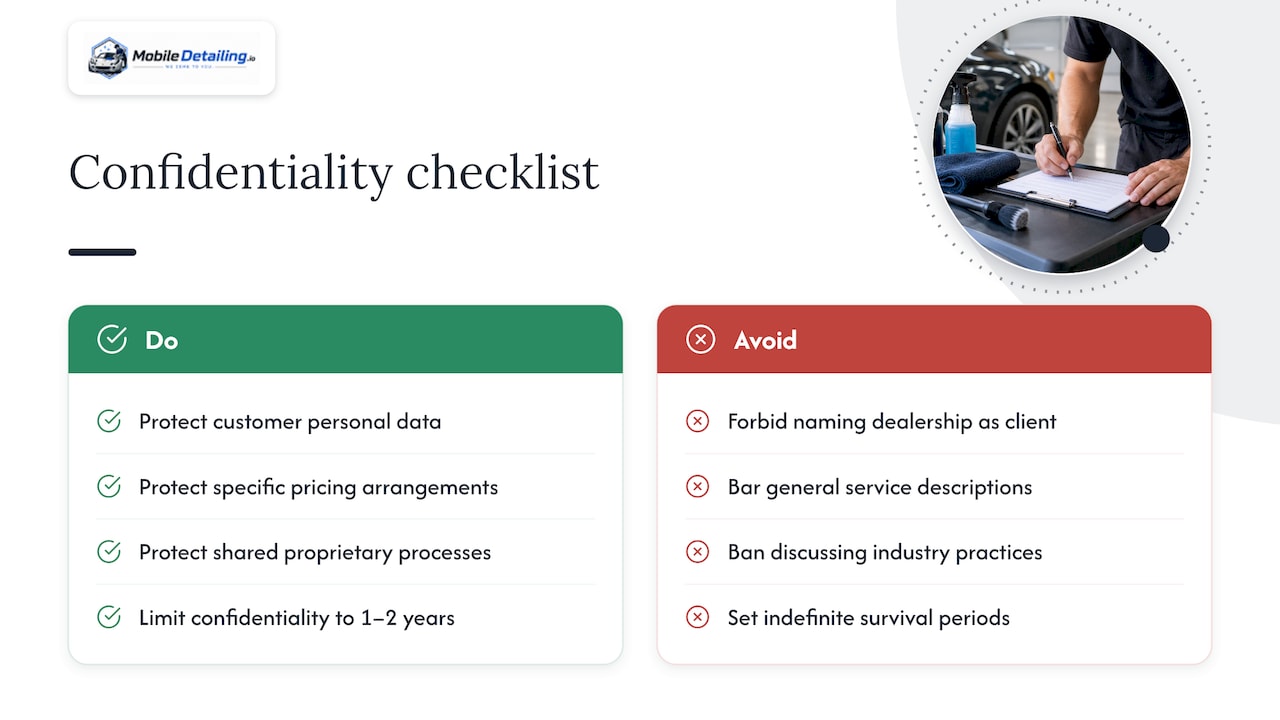
Dealerships often ask detailers to sign a confidentiality clause covering customer information, pricing data, or internal processes seen while working on-site. That request is reasonable within limits, but the clause should be specific about what counts as confidential rather than broadly restricting you from discussing the relationship at all.
A fair confidentiality clause covers customer personal data, specific pricing arrangements, and any proprietary processes the dealership shares, but it should not prevent you from naming the dealership as a client, listing general service descriptions on your own marketing materials, or discussing industry-standard practices. Watch for language that extends confidentiality indefinitely after the contract ends. A one to two year survival period after termination is standard; an indefinite restriction is worth pushing back on.
If the dealership wants a mutual non-disclosure agreement rather than a one-sided clause buried in the service contract, that’s often a better structure, since it obligates both parties equally and tends to use clearer, narrower language. Either way, read the definition of “confidential information” carefully. A clause broad enough to cover “any information learned during the engagement” can unintentionally restrict you from using general experience gained on the job, which matters if you want to describe your dealership work in future marketing or when bidding on similar contracts elsewhere.
Compliance with environmental and safety regulations
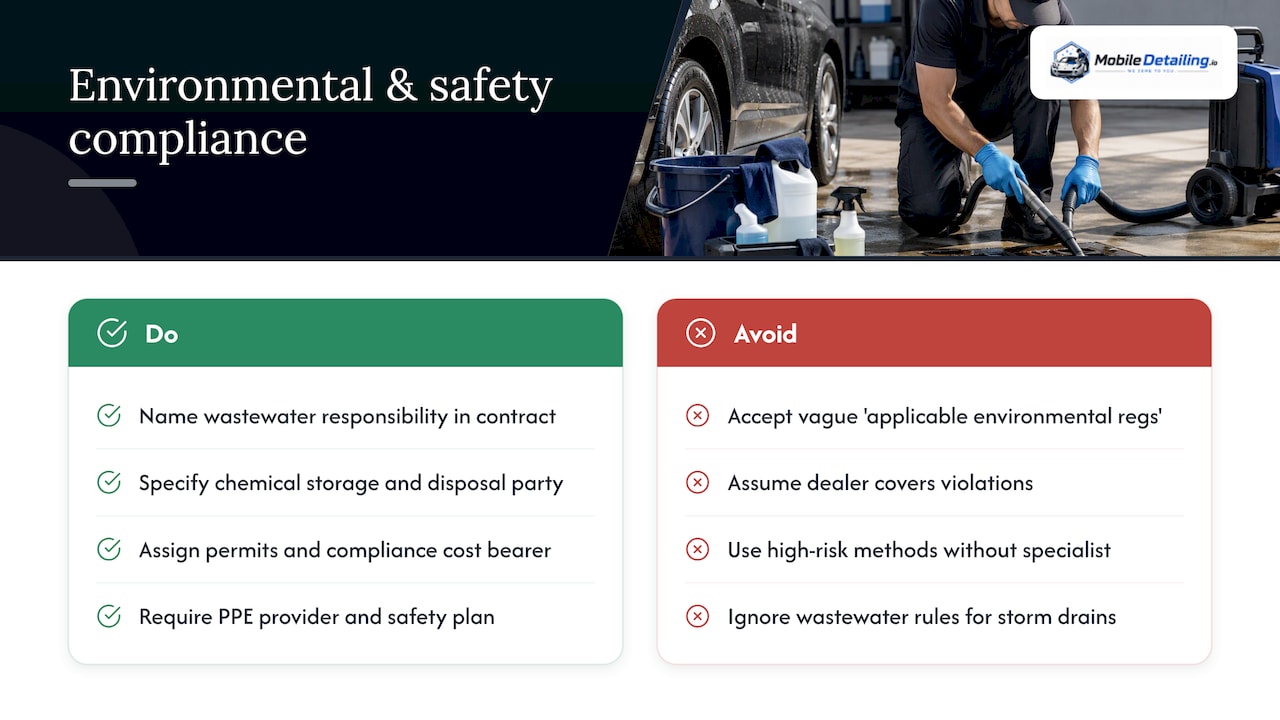
Mobile and on-site detailing involves chemicals, wastewater, and equipment that fall under state and local environmental rules, and a dealership contract sometimes shifts compliance responsibility onto the vendor without naming the specific standards involved. Clarify which party is responsible for wastewater runoff, chemical storage, and disposal of used materials like rags, filters, or coating byproducts, since local regulations on these vary and the contract should say who handles permits or compliance costs if a violation occurs.
Safety requirements deserve the same clarity. If you’re working in a dealership’s service bay or on an active lot, the contract should specify who provides personal protective equipment, how vehicle lifts or shared equipment get used safely, and what happens if a safety incident occurs on dealership property. For high-risk tasks like paint correction involving solvent-based products, wet sanding, or ceramic coating application that requires careful ventilation and chemical handling, bring in a professional detailer experienced with those specific processes rather than assuming general detailing experience covers it.
Some states and municipalities regulate mobile detailing wastewater discharge directly, particularly when work happens over storm drains or unpaved surfaces. A contract clause acknowledging compliance with “applicable environmental regulations” without naming jurisdiction-specific rules leaves ambiguity about who’s responsible if a local inspector flags a violation. Where the contract is silent, ask the dealership directly which regulations they expect you to follow on their property, and get the answer in writing.
Data protection and privacy considerations
Detailers working at a dealership often have incidental access to customer vehicles that contain personal information, from garage door codes stored in a car’s system to paperwork left in a glove box. The contract should address what happens with any customer data or personal property you encounter during service, even though this risk gets overlooked more often than insurance or pricing terms.
A reasonable data protection clause requires you to report any customer information or personal items found in a vehicle to the dealership rather than retaining or using it, and prohibits copying or storing any customer data accessed through connected vehicle systems. If the dealership uses a shared scheduling or customer management platform that gives you login access, the contract should specify what you can view, how long your access lasts after the engagement ends, and who’s responsible if that access is misused.
This section rarely needs to be lengthy, but it should exist. A short paragraph requiring reasonable care with any customer information encountered during service, paired with a requirement to immediately return or report anything found in a vehicle, covers most of the practical risk without turning the contract into a full data-privacy agreement.
Force majeure and unforeseen events clauses
A force majeure clause excuses both parties from performance when something outside their control makes it impossible, severe weather, a natural disaster, a supply shortage on detailing materials, or a government shutdown order. Without this clause, a missed deadline caused by circumstances no one could control might still count as a breach of contract, which exposes you to a penalty for something you couldn’t have prevented.
The clause should name specific triggering events rather than relying on vague language like “acts of God,” since a narrow, enumerated list is easier to apply when a dispute arises over whether a particular event actually qualifies. It should also state what happens next: does the contract pause, does the deadline extend by the length of the disruption, or does either party get the right to terminate if the disruption lasts beyond a set number of days, often 30 to 60.
Detailers relying heavily on one dealership account should pay attention to how broadly the force majeure clause is written, since dealerships sometimes try to include routine business disruptions, like a slow sales month or an unrelated supplier issue, under the same umbrella as true emergencies. That’s a different risk than a hurricane shutting down the lot for a week, and the contract should distinguish between the two rather than letting the dealership invoke force majeure for ordinary business fluctuations.
How MobileDetailing.io can help detailers find dealer-type leads and present proof of performance
Finding the first commercial account, dealership or otherwise, usually comes down to visibility and a profile that answers the questions a buyer would otherwise ask over email. A claimed listing on Mobiledetailing lets you display photos, service categories, and reviews in one place, which reduces the paperwork friction many commercial clients expect before a first conversation.
Detailers managing fleet or commercial accounts can also review alternatives to dealership fleet servicing to understand how service boundaries are typically defined in adjacent commercial repair work. Ready to put your profile in front of buyers searching by location? Claim or upgrade your listing or get a local quote to start building the track record dealerships ask to see.
This article is general information, not a substitute for advice from a qualified lawyer. Consult a qualified legal professional about your own circumstances before acting on anything here.
FAQ
How much do you get paid to detail cars at a dealership?
Pay varies widely by region, service type, and whether you’re paid per vehicle or on an hourly basis, and no single rate applies across the industry. Review the pricing model proposed in your contract and compare it against your own cost per vehicle before agreeing to a rate.
Are dealership service contracts worth it?
A written contract is worth having whenever you take on recurring dealership work, since it protects your payment terms, limits liability exposure, and clarifies insurance requirements. Without one, disputes over scope, payment timing, or damage claims have no clear reference point to resolve them.
How profitable is car detailing?
Profitability depends on your pricing model, volume, and overhead costs like materials and labor, and it varies significantly between independent retail work and dealership contracts. A dealership account can offer steady volume, but only if the negotiated rate covers your true cost per vehicle after accounting for turnaround pressure and insurance requirements.
How much does a detail cost at a dealership?
Dealership detailing costs depend on the service tier, vehicle condition, and the specific contract rate negotiated between the vendor and the dealership, so there’s no fixed industry price. A clear per-vehicle or tiered pricing structure in the contract, as discussed in the pricing section above, is what actually determines the cost on any given job.
Sources
- Dealerships avoid wage claims against detailer: 4 tips to keep it a “them” problem | Fisher Phillips LLP
- IRS SS-8 worker classification determination (case excerpts)
- COI Tracking for Car Dealerships: Certificate of Insurance Compliance for Auto Dealers
- Driven: NADA dealer insurance guidance (excerpt)
MobileDetailing.io provides general educational information. Products, surfaces and vehicle finishes vary. Follow manufacturer instructions and consult a qualified detailing professional before using abrasive processes or chemical treatments.