Book More Jobs This Week: Detailing Lead Generation for Detailers
The fastest, most reliable way to generate qualified detailing leads is to get your Google presence right first: an accurate Google Business Profile with correct service-area settings, paired with a fast response workflow. Once that foundation works, test Google Ads or Local Services Ads for volume, and add a directory listing on a platform like Mobiledetailing as a complementary source of quote requests.
Table of Contents
- Top channels and tactics that generate detailing leads
- Paid search and lead assets: what actually converts
- Local SEO and Google Business Profile for service-area detailers
- Lead-to-booking workflow that turns inquiries into paid jobs
- Qualifying leads and measuring ROI
- Tools, automation, and compliance basics
- How MobileDetailing.io works as a directory and lead-generation platform
- Retargeting and follow-up marketing that converts leads into bookings
- Basic costs and how competition or seasonality affect paid lead prices
- Get more quote requests with a MobileDetailing.io listing
- Sources
- FAQ
Top channels and tactics that generate detailing leads
Not every channel deserves equal attention, and the right mix depends on how established your business already is.
Google organic search remains the backbone for most detailers, because customers searching “mobile detailing near me” trust the map results and profile photos before they trust an ad. A complete Google Business Profile with accurate service-area settings, current photos, and a running stream of reviews will out-produce almost any other channel for a service-area business. Pair that profile with a simple local blog covering seasonal topics (winter salt removal, pollen season, pre-sale detailing) and a before-and-after photo gallery, since both give Google fresh content to index and give prospects proof of your work.
Directories and marketplaces, including MobileDetailing.io, add a second discovery surface without replacing your GBP. Customers who browse a directory to compare local detailers can submit a quote request directly, which becomes another inbound channel alongside your Google presence rather than a substitute for it.
Social platforms work best as a trust-builder rather than a direct lead source. A short list of what tends to perform:
- Instagram before/after carousels that show the same panel or interior in two frames.
- Short-form video (Reels or TikTok) showing a five-second transformation moment, like a stained seat or oxidized headlight.
- YouTube how-to clips that answer common questions, which often drive branded search later.
Referrals and partnerships close the loop. Car dealerships, detailing-adjacent shops (tint, PPF, mechanics), car clubs, and fleet managers all see vehicles that need detailing regularly. A simple referral offer, a flat credit or a percentage off the referring party’s next service, gives partners a reason to mention you by name.
As a rule, growing businesses should double down on organic and referrals first, since both compound over time, and shift dollars into paid channels only once the response workflow below can handle the extra volume without slowing down.
Paid search and lead assets: what actually converts
Paid channels can produce volume fast, but the asset you choose determines whether that volume turns into booked jobs or wasted spend.
Lead form assets let a prospect submit their name, phone, and service need directly inside a Google ad, without leaving the search results page. Google offers a “more volume” setting that lowers the bar for submission and a “more qualified” setting that adds friction to filter out casual browsers. Detailers with a CRM should connect it through the export or webhook integration, since leads are only available through the API or webhook for up to 60 days after submission.
Call assets and call reporting work well for detailers because phone conversations let you quote accurately on the spot. Google’s call reporting assigns forwarding numbers so calls placed from an ad can be tracked as conversions, and calls lasting over 15 seconds can report caller number and duration; some accounts can also apply AI analysis to help flag lead quality, though that classification should be checked against actual booking outcomes rather than trusted outright.
Local Services Ads are built specifically for service-area businesses and differ from standard search ads in that they emphasize verified reviews and background checks over keyword bidding, making them a natural fit for mobile detailers who serve a defined radius rather than a fixed storefront.
A sensible testing plan:
- Start with a small daily budget and one campaign focused on your core service.
- Track booked jobs, not raw inquiries, as the real success metric.
- Compare cost per lead against cost per booked job weekly before increasing spend.
Local SEO and Google Business Profile for service-area detailers
Google gives service-area businesses a specific set of rules, and getting them wrong can suppress your visibility even if everything else looks fine.
- Set your service area by city or postal code rather than relying on a radius, since Google’s own service-area guidance recommends defining coverage this way for service-area and hybrid businesses.
- Hide your street address if you operate as a mobile business with no walk-in location, and keep a single legitimate profile rather than creating duplicates for each town you serve.
- Fill in every essential field: business name, phone number, website, hours, a full services list, current photos, and timely responses to every review.
- Collect reviews continuously rather than in one push, since recent industry research from BrightLocal shows reviews function as one of the strongest trust signals customers use when picking a local business.
Ask for reviews in person right after the job, then follow up by email or text with a direct link or QR code for anyone who did not leave one on the spot. Spread requests across Google, Facebook, and your directory listings so your reputation is not resting on a single platform.
Keep your MobileDetailing.io listing and your Google Business Profile clearly separate. Google’s guidelines on representing your business make clear that a marketplace or lead-generation listing should never be presented as your own verified profile.
Pro Tip: Update your GBP photos every few weeks, since a profile that looks recently active tends to earn more attention in local search than one with stale images from a year ago.
Lead-to-booking workflow that turns inquiries into paid jobs
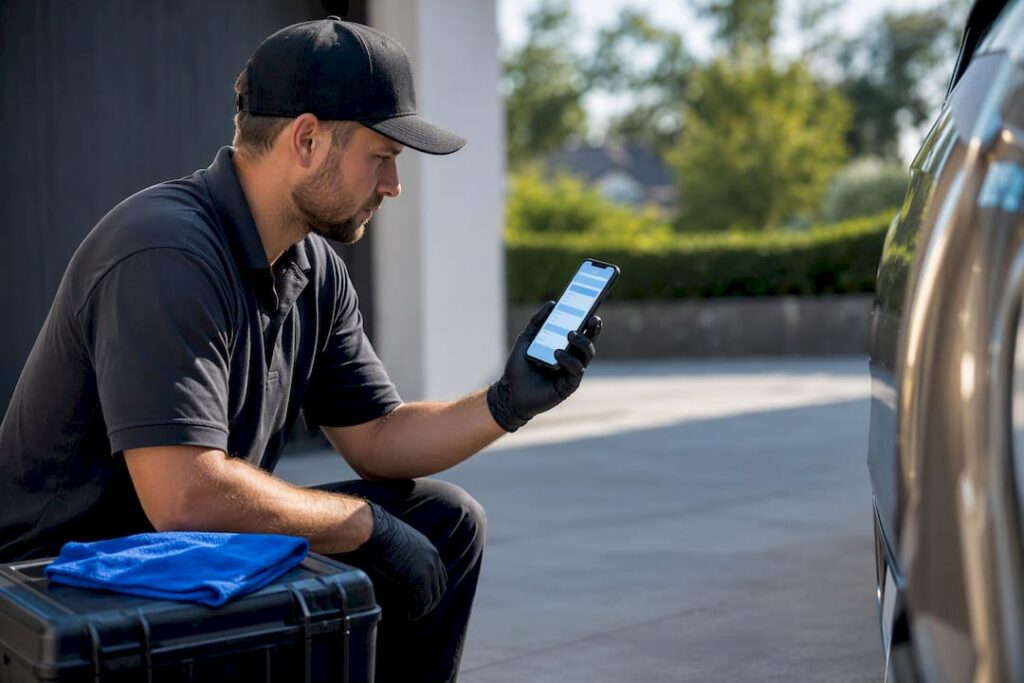
Marketing only works if the operational side can catch what it produces. A prospect who fills out a form or calls expects a response within minutes, not hours, and the businesses that respond fastest tend to win the job regardless of price.
- Acknowledge every phone or text lead immediately, ideally within a few minutes, even if the full quote takes longer to prepare.
- Use a short phone or SMS script that confirms the vehicle type, service needed, and preferred date before quoting a price.
- Keep a one-page checklist for common services (interior detail, exterior detail, ceramic coating) so quotes stay consistent between staff.
- Offer online scheduling and multiple payment options to remove friction between “yes” and a booked appointment.
- Track opt-outs and no-shows in a suppression list so you are not re-contacting people who already declined.
- Schedule an in-person assessment before quoting paint correction or ceramic coating jobs, and set the customer’s expectations that a technician needs to see the paint condition first.
Any work involving wet sanding, machine paint correction, or coating application should be handled by a trained professional, since misjudging paint thickness or chemical exposure can cause damage that is expensive to fix.
Qualifying leads and measuring ROI
A lead is only “qualified” once it meets a few basic conditions, and testing that definition before spending on ads saves money later.
- The prospect is inside your actual service area.
- They are requesting a service you perform.
- You have a reachable phone number or email.
- They give a realistic date window, not “someday.”
Track at minimum: lead source, response time, contact outcome, estimate given, booking result, revenue, and any cancellation. Connecting call reporting and lead-form exports back to your booking calendar, as described in Google’s guidance on tracking calls and conversions, is what lets you calculate cost per booked job rather than cost per raw inquiry.
Reviews are one of the strongest trust signals in local search, according to BrightLocal’s consumer research. A profile with recent, responded-to reviews tends to convert better once a prospect reaches it, which is why review velocity belongs on the same tracking sheet as your ad metrics.
A simple formula: divide total marketing spend for a period by the number of jobs actually booked from that spend to get cost per booked job. Compare that figure against average job value and repeat-customer rate to understand real return, rather than judging a channel on lead volume alone.
Tools, automation, and compliance basics
A handful of tool categories cover most of what a growing detailing business needs: a contact and booking CRM, two-way SMS for fast follow-up, call-tracking for paid campaigns, and lead-form integrations or webhooks that push new submissions straight into your calendar.
Automation should handle the first acknowledgment and then hand off to a person for anything beyond a scripted confirmation. Build in suppression lists for opt-outs and a consent record for anyone who agrees to text or email follow-up.
- Automate the “we got your request” confirmation, then escalate to a human for quoting.
- Capture explicit consent before adding anyone to a recurring text or email sequence.
- Keep an accurate, current opt-out list and honor removal requests without delay.
If you send marketing emails, the FTC’s CAN-SPAM guidance requires a working opt-out mechanism, honest sender identity, and a valid postal address in every message, with opt-outs honored promptly.
Pro Tip: Never let automation attempt to diagnose paint condition or recommend a coating thickness by chat. That call belongs to a technician who can see the vehicle.
How MobileDetailing.io works as a directory and lead-generation platform
Mobiledetailing is a nationwide directory that connects vehicle owners with local mobile detailing professionals. Customers search by location, compare businesses offering interior detailing, exterior detailing, ceramic coating, paint correction, and window tinting, then submit quote requests directly through a listing.
Detailers can claim or create a free or paid listing, add service categories, upload photos, and collect reviews on the platform itself. Listings such as Golden Detail Mobile Detailing in Tacoma or Protech Detailing in Phoenix show the typical format: services offered, photos, and customer reviews in one profile. Use a directory listing to add a second discovery surface, not to replace a verified Google Business Profile, which stays the priority under Google’s own service-area rules.
Retargeting and follow-up marketing that converts leads into bookings
Most people who request a quote do not book on the first contact, which makes follow-up the difference between a wasted lead and a paid job.
Retargeting ads on Google’s display network or on social platforms can keep your business visible to someone who visited your site or requested a quote but did not schedule right away. Because detailing is often a considered purchase, a second or third touch, showing a before-and-after result or a seasonal reminder, tends to recapture interest that a single ad exposure missed.
Email and SMS follow-up sequences work alongside retargeting ads. A short sequence might include a same-day confirmation, a two-day check-in if no response, and a one-week reminder tied to a seasonal hook like pollen season or road salt. Keep the tone helpful rather than pushy, and always include a working opt-out in emails per CAN-SPAM requirements.
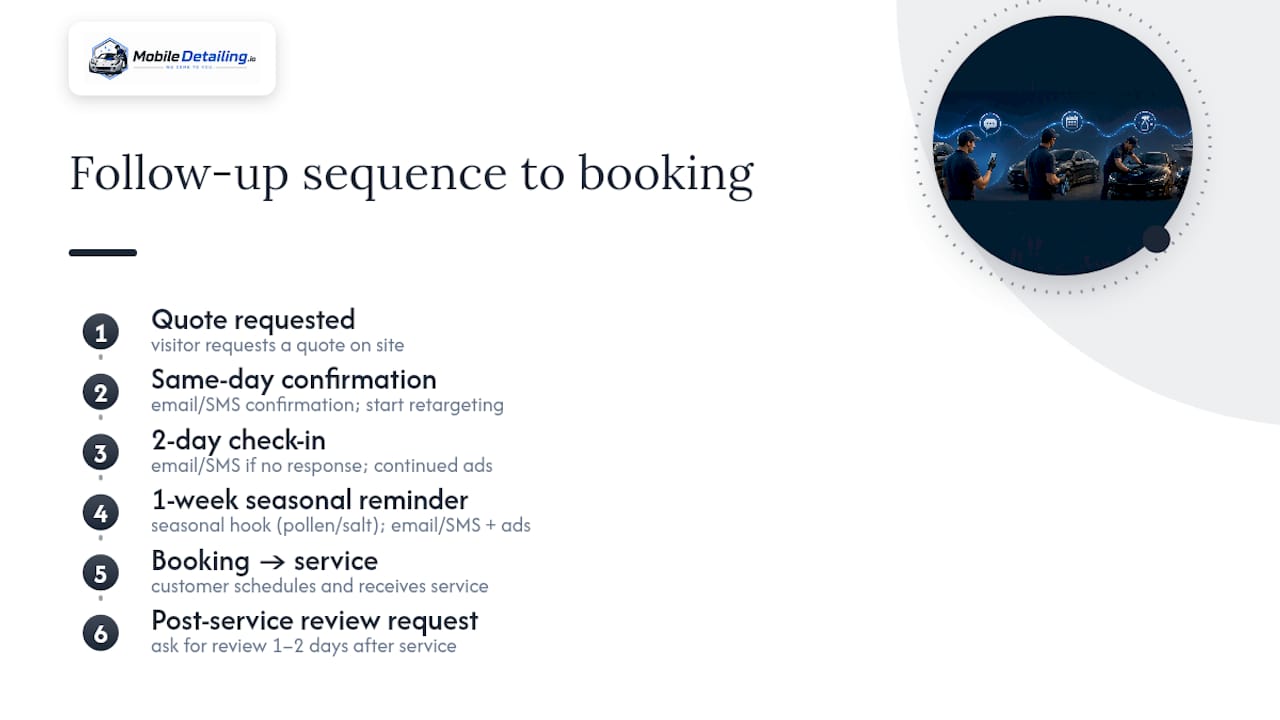
Reviews double as a retention tool here too. A follow-up message that asks for a review a day or two after service, alongside a note that you are available for their next detail, keeps the relationship open without feeling like a hard sell.
Segment your list where possible: someone who asked about ceramic coating has a different follow-up path than someone who wanted a basic wash and vacuum, and treating them the same wastes the opportunity.
Basic costs and how competition or seasonality affect paid lead prices
Paid lead costs on Google Ads or Local Services Ads move with local competition and demand, and both can shift sharply by season and by market. A detailer in a market with several established competitors bidding on the same keywords will generally see a higher cost per click or per lead than one in a less contested area, and costs typically climb during peak seasons when everyone is trying to book spring and summer detailing work at once.
Because paid costs fluctuate with local supply and demand rather than a fixed rate, the more reliable approach is to track your own cost per booked job over time rather than compare notes with another detailer in a different market. Organic search, referrals, and directory listings carry no per-click cost, which is part of why building those channels alongside paid ads gives a more stable base of leads through slow seasons.
Get more quote requests with a MobileDetailing.io listing
Claiming a free or paid listing on MobileDetailing.io gives you another place customers can find you and request a quote without competing for the same paid search clicks everyone else is bidding on. It works alongside your Google Business Profile and ads rather than replacing either one.
- Claim or create your listing and add your services, service area, and photos.
- Enable quote requests so prospects can reach you directly from your profile.
- Send new inquiries into the same fast-response workflow you use for phone and ad leads.
Vehicle owners can also get a local quote right now to see how the request lands with nearby detailers, which gives you a preview of the experience your own future leads will have.
Sources
- Lead form asset overview – Google Ads Help
- CAN-SPAM Act: A Compliance Guide for Business | Federal Trade Commission
- BrightLocal Local Consumer Review Survey (2025/2026)
FAQ
Is detailing a profitable business?
A detailing business can be profitable when it keeps overhead low and prices jobs to cover materials, time, and travel, since mobile setups avoid the rent of a fixed shop. Profitability depends heavily on booking consistency, which is why a reliable lead workflow matters as much as the detailing work itself.
How much do detailers make per car?
Per-car earnings vary widely by service type, region, and vehicle size, with basic washes priced far lower than full paint correction or ceramic coating jobs. There is no single published industry figure for this, so detailers typically set pricing based on local competition and their own time and material costs.
How do I start a car detailing business with a small budget?
A low-budget start typically means beginning as a mobile operation with basic equipment, a smartphone for photos and scheduling, and a free Google Business Profile and directory listing to generate initial leads. Reinvesting early job revenue into better equipment and marketing tends to be more sustainable than borrowing heavily upfront.
How much should I tip for a car detail?
Tipping for a detail is optional and varies by region and service quality, similar to other personal service industries, with no fixed standard percentage. Some customers tip a flat amount or a percentage of the total service price when they are satisfied with the work.
Recommended
- Gr8 Detailing Co. – Detailing Services in Memphis, TN
- Golden Detail – Mobile Detailing – Detailing Services in Tacoma, WA
- Deluxetailing Mobile Detailing – Detailing Services in San Antonio, TX
- Premier Mobile Detailing – Detailing Services in Seattle, WA
MobileDetailing.io provides general educational information. Products, surfaces and vehicle finishes vary. Follow manufacturer instructions and consult a qualified detailing professional before using abrasive processes or chemical treatments.