Detailing Membership Plans: What They Cost and Who Benefits
A detailing membership is a recurring plan: you pay a set price, usually monthly, and a detailer comes back on a schedule to wash, clean or maintain your vehicle. For the right driver it beats booking one-off details, because the price is lower per visit and the car never gets far from clean. For the wrong driver it is one more charge that runs on autopilot. This guide covers how these plans are built, how to do the math for your own car, which questions to ask before you pay, and where a membership stops and a specialist job begins.
Table of Contents
- What a detailing membership actually is
- Membership, one-off detail or car wash plan?
- What the tiers usually include
- Do the math before you sign
- Questions to ask a detailer before you join
- Cancellation rules: what is and is not settled
- Where a membership ends and specialist work begins
- Beyond cars: boats, RVs and other vehicles
- How to find a mobile detailer who offers a plan
- Find a local detailer on MobileDetailing.io
- Frequently asked questions
- Sources
What a detailing membership actually is
Most plans fall into the same three shapes, whatever the detailer calls them:
- Maintenance washes. A recurring exterior wash, often with a quick interior vacuum and wipe-down. These are the cheapest and the most frequent, commonly every one to two weeks.
- Scheduled details. One full interior and exterior detail per month, every other month or every quarter. This is closer to a traditional detail on a discount.
- Tiered or add-on plans. A base visit plus a higher tier that bundles extras, such as sealant top-ups, interior conditioning or coating maintenance.
The word “membership” is loose. Some businesses sell a true subscription that renews automatically on your card. Others sell a prepaid bundle of visits, or a loyalty discount that applies whenever you book. Those three behave very differently when you want to pause or leave, so the first job is working out which one you are being offered.
Mobile plans add one more variable: the detailer comes to your driveway, office lot or apartment parking area. That saves you the drive and the wait, but it also means the plan depends on water and power access, parking rules and weather. We cover that below.
Membership, one-off detail or car wash plan?
It helps to separate three things people lump together.
| Option | Best for | Main trade-off |
|---|---|---|
| Tunnel or automatic car wash plan | Drivers who just want quick exterior rinses, many times a month | Surface cleaning only, no interior work, no hand finishing |
| One-off detail | Cars that need a deep reset, a sale-ready clean, or a seasonal refresh | Highest cost per visit, cleanliness fades between bookings |
| Mobile detailing membership | Owners who want the car kept consistently clean without taking time out | You commit to a schedule, and you pay whether or not you needed that visit |
Do you need hand detailing at all? Consumer Reports says the average driver does not strictly need intensive hand detailing. For many cars, regular washing, a touchless automatic wash, seasonal waxing and vacuuming are enough to protect the clearcoat. That is a fair benchmark. A membership makes sense when you want more than the minimum: a cleaner interior, hand washing that avoids swirl-prone brushes, or simply someone else doing the work.
What the tiers usually include
Plans vary by business, so read the actual service list, not the tier name. Still, the pattern is consistent.
Entry tier: exterior or interior maintenance
Expect a hand wash, wheels and tires cleaned, windows, and a quick interior pass: vacuum, dash and door wipe-down, glass. Entry plans are built for cars that are already in decent shape. If your car starts out with pet hair, stained seats or heavy odor, the first visit usually needs to be a full detail at regular price, and the plan takes over from there.
Mid tier: full interior and exterior detail on a schedule
Here the visit is longer and more thorough. Interior surfaces are cleaned and conditioned, carpets and mats are extracted or deep cleaned as needed, and the exterior gets a proper wash plus a spray wax or sealant. Frequency is the main lever: monthly keeps a car close to showroom, while every other month or quarterly suits lower-use vehicles.
Top tier: protection and coating care
Higher tiers often add paint protection upkeep. That can mean sealant reapplication or a maintenance wash designed for a coated car. Consumer Reports notes that waxing lasts several weeks before it needs reapplying, with a seasonal schedule recommended, so a plan that refreshes protection every few months lines up with how those products actually wear.
Two cautions apply to this tier. First, ask exactly which products are used and what the detailer will do if the paint needs correction. Second, remember that a standard wash plan does not replace deep decontamination, polishing or coating work. Those are separate, infrequent jobs.
Multi-vehicle and household plans
Some detailers price a plan per vehicle, others discount when a household or small business adds a second or third car. If you have a family fleet, ask whether the discount applies to the whole plan or only the added vehicles, and whether vehicles can be swapped between visits.
Do the math before you sign
The central question is simple: will you use enough visits to come out ahead? Capital One’s auto guide makes the same point about car wash subscriptions: depending on how often you wash, a plan can save money, and for light users it does not. Clark.com gives a clean example. If a single wash costs $10 and unlimited access costs $20 a month, you need at least three visits a month to break even.
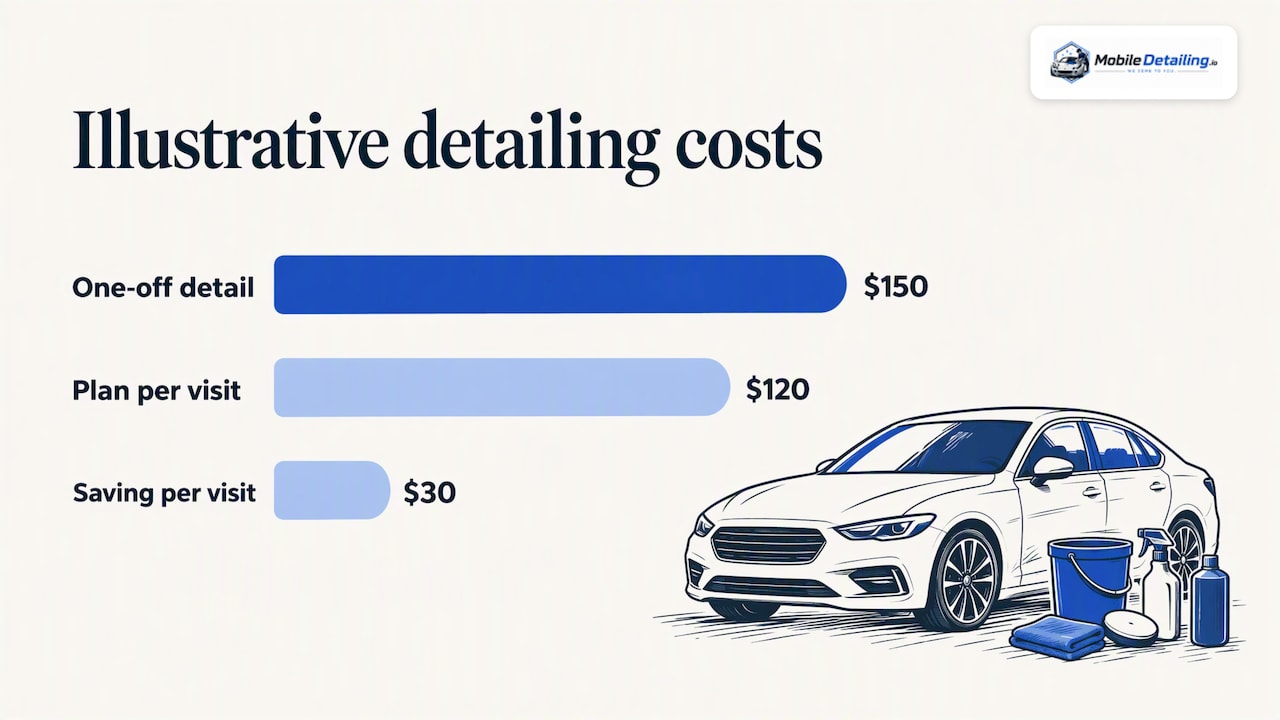
The same logic works for detailing, with bigger numbers. The figures below are an illustration, not a quote from any business:
- Find the one-off price of the visit you would book. Say a maintenance detail costs $150 as a single appointment.
- Find the plan price per visit. Say the plan is $120 a visit, billed monthly.
- Multiply the difference by the visits you will really use in a year. Twelve visits at a $30 saving is $360.
- Subtract any setup fee, and count any months you would have skipped anyway.
If you would only have booked a detail four times a year, the plan costs you eight visits you did not want, and the savings vanish. If you would have booked every month regardless, the plan wins. The honest answer depends on your habits, not on the sticker price.
Track your real habits first
Clark.com also suggests a practical test: track how often you actually wash the car over two or three months before committing. Do the same for detailing. Note when the interior gets bad enough that you would pay to fix it, and when the exterior bothers you. That log tells you whether to choose weekly, monthly or quarterly.
Who tends to get the most value
- Rideshare and delivery drivers, whose cars take daily wear and need regular interior cleaning.
- Families, where crumbs, spills and odors build up on a predictable schedule.
- Commuters and busy professionals who would rather not give up a Saturday.
- Owners of dark or high-maintenance paint, which shows dirt and swirls quickly.
- Small business owners and fleet managers keeping several vehicles presentable.
Who should probably skip it
- Garage-kept weekend cars that rarely get dirty.
- Drivers who like washing their own car and only want a periodic deep clean.
- Anyone whose schedule is unpredictable and cannot be home or at work for a set appointment.
Questions to ask a detailer before you join
Plans are easy to advertise and easy to misread. Get answers to these in writing, in the booking confirmation or the terms.
- What is included at each visit? A checklist beats a tier name. Ask about interior vacuuming, windows, wheels, tire dressing, spray sealant and any limits on vehicle size or condition.
- What is the true monthly cost? Include setup fees, an initial detail that is billed separately, taxes, travel charges, and extra fees for third-row SUVs, trucks or heavy pet hair.
- What happens if you skip or reschedule? Do unused visits roll over, expire or get charged anyway? How much notice is required, and is there a fee for a missed appointment?
- What does the detailer need at your location? Mobile detailers may need water, electricity, shade or a flat surface. Ask whether they bring their own, and what happens in rain, heat or snow.
- How do you cancel? Ask for the exact steps, whether there is a minimum term, and whether the billing date is a cutoff for stopping the next charge.
- Is the same person coming each time? Consistency matters if you want the same standard and the same attention to your car.
- Is the business insured? Ask directly, and ask what happens if your vehicle is damaged during service. We cannot verify this for a business on your behalf, so get the answer from the detailer.
Cancellation rules: what is and is not settled
Cancellation is where most membership regret begins. You may have seen headlines about the Federal Trade Commission’s “click to cancel” rule. The FTC finalized amendments to its Negative Option Rule in late 2024, and its own guidance described the aim: clear disclosure of terms and an easy way to cancel.
That rule did not survive. On July 8, 2025, the Eighth Circuit vacated the rule on procedural grounds, according to a law firm analysis, which also expects federal and state regulators to keep policing deceptive subscription practices. So you should not assume a detailer is legally required to offer one-click cancellation. Rules on automatic renewals vary by state, and some states have their own requirements. If you need specifics, check your state attorney general’s consumer protection page or ask a local consumer attorney.
What you can do is protect yourself with the contract:
- Ask whether the plan renews automatically and on what date.
- Look for a cancellation method that matches how you signed up, such as text or email for a plan booked by text.
- Save the confirmation and any terms page.
- Put a calendar reminder for a few days before each renewal during the first three months.
- If you are charged after cancelling, contact the business first with your records, then your card issuer if it is not resolved.
A detailer who explains cancellation plainly before you pay is usually the one who is comfortable with it.
Where a membership ends and specialist work begins
A maintenance plan keeps a clean car clean. It does not fix everything. Consumer Reports describes regular washing as protection against corrosive road salt, bird droppings and tree sap, and notes you should not let sap or droppings sit for days. A membership helps with that routine. It will not take the place of:
- Paint correction. Removing swirls, scratches and oxidation is skilled work with machine polishers. Wet sanding, which removes a thin layer of clearcoat, can cause permanent damage if done wrong. Leave both to a professional.
- Ceramic coating. Preparation matters as much as the product. Coatings are best installed by a trained professional, and the manufacturer’s claims about durability are marketing until you see independent evidence. Ask the installer what warranty terms actually cover and what maintenance they require.
- Hazardous chemical work. Heavy-duty acid wheel cleaners, strong solvents and some mold or biohazard treatments call for proper protective gear and ventilation. This is not a job to try in your garage after a plan visit.
If you own a coated vehicle, check whether the plan uses wash products and methods that suit coatings. Some detailers offer higher-tier plans that include coating maintenance. If you are researching coatings, you can browse ceramic coating providers in Cleveland or look at a specialist such as Ceramic Coat Texas in Austin to see how shops describe their work.
Vehicles with graphics and decals
Commercial vehicles and rideshare cars often carry vinyl lettering or wraps. Before any plan starts, tell the detailer what is on the vehicle and ask how they wash around it. If you are planning new lettering, it helps to know how vinyl car decals are specified and produced, since quality and installation affect how the graphics hold up to repeated washing.
Beyond cars: boats, RVs and other vehicles
Recurring plans are not only for cars. Boat owners often want a regular wash and wax through the season, and RV owners may want a monthly exterior wash while the vehicle is in use. Marine work has its own demands: gelcoat, vinyl, canvas and teak are different surfaces, and saltwater exposure shortens the interval between cleanings. If that sounds like you, look for a detailer who works on boats routinely. For example, MobileDetailing.io lists marine specialists such as Clean Marine Detailing in Greenville, NC and has a marine detailing page for San Francisco. Ask each one whether they offer recurring service, because a listing alone does not tell you.
How to find a mobile detailer who offers a plan
The strongest plans come from detailers who already do good one-off work. A practical approach:
- Start with a single detail. Book one visit before you commit to a recurring plan. You will see punctuality, communication and quality.
- Compare by region. Prices and availability differ by metro area. You can search by location on MobileDetailing.io and open listings from detailers near you, such as Mobile Detailing Lab in Cincinnati or Premier Mobile Detailing in Seattle.
- Read reviews for patterns. One bad review is noise. Repeated mentions of no-shows or rushed work are not.
- Ask for the plan in writing. Request the service list, price, billing date and cancellation terms before you hand over a card.
- Review after three months. If you have used every visit and the car is clearly better kept, keep it. If not, drop to a lower frequency.
Many listings do not state recurring plans, so the quickest route is often to ask. The local quote form lets you describe your vehicle and the schedule you want, and detailers in your area can respond with what they offer.
Find a local detailer on MobileDetailing.io
MobileDetailing.io is a nationwide directory that connects vehicle owners with local mobile detailers for interior and exterior detailing, ceramic coating, window tinting, marine and aircraft work, and more. Searching is free for vehicle owners. Browse by location on the MobileDetailing.io home page, compare businesses, and send a quote request that mentions the recurring schedule you have in mind.
Frequently asked questions
Is a monthly detailing subscription worth it?
It is worth it if you would book the same visits anyway and the plan price per visit is lower than the one-off price. It is not worth it if you would use only a few visits a year. Work out your cost per visit before you commit, and count any setup fee.
How much does a detailing membership cost?
It depends on your area, vehicle size, visit length and frequency. A basic maintenance wash plan costs much less than a monthly full detail. Because prices vary so widely, get quotes from several local detailers rather than relying on a national average.
Can I cancel a detailing membership any time?
Not always. The FTC’s click-to-cancel rule was vacated by a federal appeals court in 2025, so terms depend on the business’s contract and your state’s law. Ask about minimum terms, notice periods and the cancellation method before you pay.
Does a membership include ceramic coating or paint correction?
A standard plan usually does not. Those are separate specialist jobs, and some detailers include maintenance for them only in higher tiers. Ask what is covered, and use a professional for both.
Is a detailing plan better than a car wash membership?
They do different jobs. A car wash plan is cheap and fast for exterior rinsing. A detailing plan adds hand work and interior cleaning, and it comes to you. Consumer Reports suggests most drivers can protect their paint with regular washing and seasonal waxing, so pick the level that matches how much you want done.
Sources
- Expert Detailing Secrets for a Cleaner Car, Consumer Reports
- How to Get Tree Sap and Bugs Off Your Car, Consumer Reports
- Are Car Wash Subscriptions Worth It?, Clark.com
- Are Car Wash Subscriptions Worth It?, Capital One Auto Navigator
- Negative Option Rule, Federal Register
- Click to Cancel: The FTC’s amended Negative Option Rule, Federal Trade Commission
- Eighth Circuit Vacates the FTC’s Click to Cancel Rule, WilmerHale
Recommended
- Compare: Price Detailing Services for U.S. Owners & Fleets ($150–$300)
- Copyable One Page Mobile Detailing Business Plan and US Startup Costs
MobileDetailing.io provides general educational information. Products, surfaces and vehicle finishes vary. Follow manufacturer instructions and consult a qualified detailing professional before using abrasive processes or chemical treatments.