Smoke Smell Removal for Your Car: What Works and When to Hire a Pro
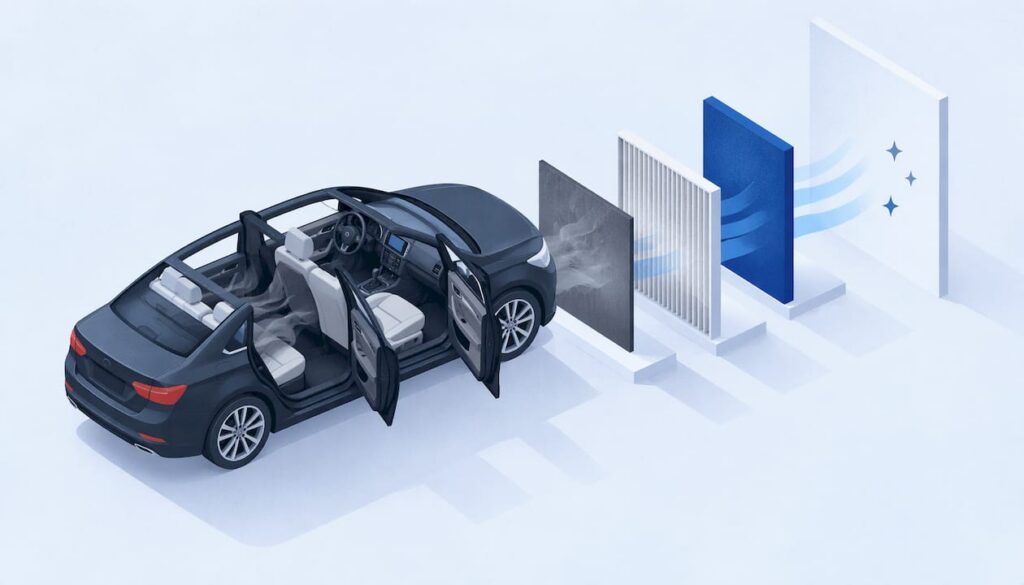
Most smoke smell can be removed from a car, but only by cleaning the places where smoke residue actually sits: the headliner, the seat foam, the carpet, and the HVAC system. Air fresheners and sprays only cover it up. A light case often yields to a careful weekend of DIY cleaning. A car with years of smoking behind it usually needs deep extraction, an HVAC treatment and sometimes ozone, which is work for a professional. A mobile detailer can do that at your home or office, and you can request quotes from local detailers on MobileDetailing.io at no cost to you.
This guide explains why the smell lingers, gives you the cleaning order that works, covers what ozone does and how to stay safe around it, and helps you decide whether to do it yourself or hire someone.
Table of Contents
- Why cigarette smell sticks to a car
- How bad is your car? Set realistic expectations
- Find out where the smell lives before you start
- The cleaning order that works
- What ozone treatment does, and why it needs a professional
- Home remedies: what to skip
- DIY or professional: how to decide
- Questions to ask a detailer before you book
- Find a mobile detailer for smoke odor
- How to keep the smell from coming back
- FAQ
- Sources
Why cigarette smell sticks to a car
Smoke does not just float in the air and leave. It leaves a film of tar and nicotine and fine particles on everything in the cabin. Hagerty explains that this residue sits in cloth seats, carpet, mats, foam padding and the fabric headliner. Smoke rises, so the headliner is often the worst spot. On the dash, steering wheel, console and glass it forms a sticky yellow-brown film you can see on a white microfiber towel.
The ventilation system is the part most people miss. Residue lodges in the cabin air filter, the ducts and the area around the evaporator (the small radiator-like part that cools the air). That is why a car can seem fine when it is parked but smell like an old ashtray the moment you switch the fan on.
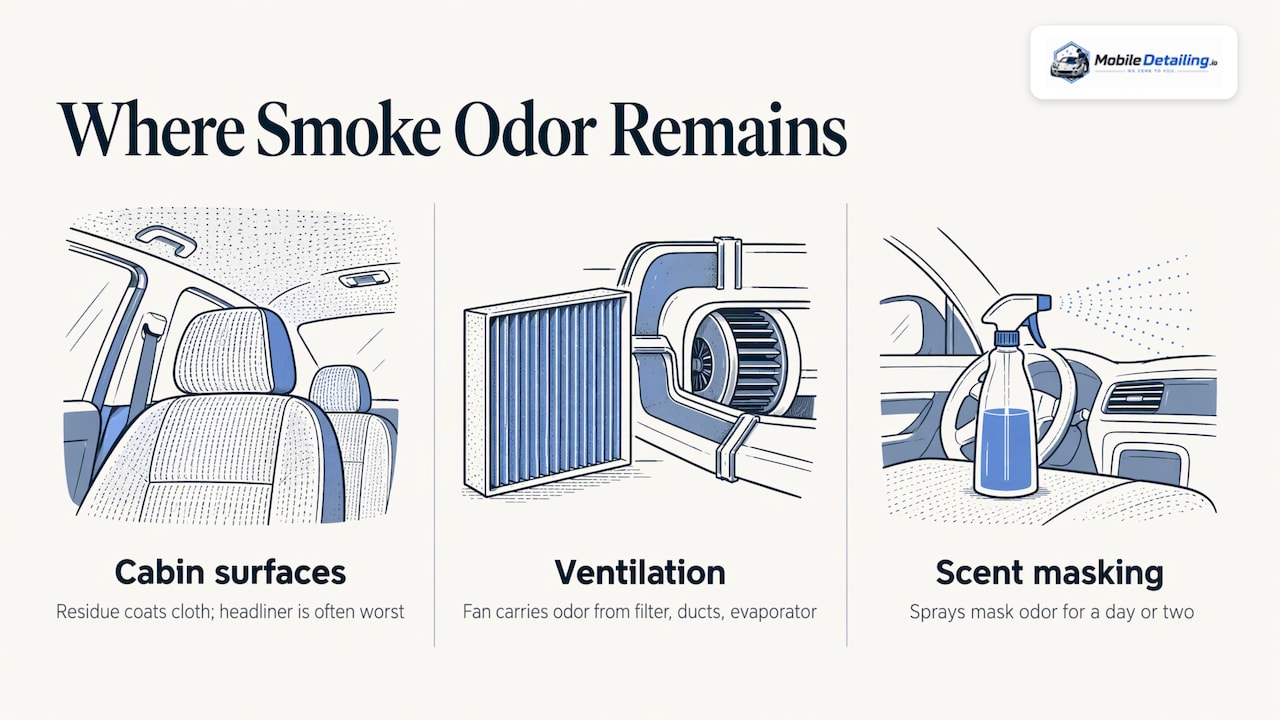
This also explains why perfume-based products disappoint. According to the same Hagerty guide, hanging trees and heavily scented sprays might disguise the smell for a day or two, but they do not remove the tar, nicotine and particles that cause it. Anything that works has to remove or neutralize the residue itself.
How bad is your car? Set realistic expectations
The outcome depends on how long and how heavily people smoked in the vehicle.
| Situation | What usually works | Realistic result |
|---|---|---|
| A few cigarettes, or a recently bought used car with a mild smell | Thorough DIY cleaning, new cabin filter, baking soda or charcoal | Smell typically gone |
| Daily smoking for a year or two | Deep extraction, headliner care, HVAC treatment, possibly ozone | Gone or faint after a professional job |
| Years of heavy smoking | Everything above, often several visits, possibly replacing padding or headliner | Big improvement; a faint trace can remain in deep foam |
| Smoking in the car continues | Cleaning cannot keep up | Smell returns |
These tiers are a practical rule of thumb, not a guarantee. A good detailer will look at the car before promising anything. Be wary of anyone who guarantees every trace of smoke will vanish without inspecting the vehicle.
Heat is a useful test. Residue off-gases when temperatures rise, so a car that smells clean on a cool morning can smell stale again on a hot afternoon. Check your results on a warm day before you decide the job is done.
Find out where the smell lives before you start
Two quick checks save you hours of scrubbing the wrong thing.
- The vent test. Run the fan on high with recirculation off and smell the air coming from the vents. If it smells like smoke, the odor is in the HVAC system, and cleaning the seats alone will not fix it.
- The surface test. Wipe the dash and the inside of the windshield with a damp white towel. A yellow or brown tint means a smoke film is still on hard surfaces and glass.
Also sniff the headliner, the seat belts and the carpet under the mats. Whichever is strongest is where you spend the most time.
The cleaning order that works
Order matters. Start with the dry, loose material and finish with the treatments that reach deep. This sequence follows Hagerty’s guide, with notes on where each step tends to go wrong.
1. Empty and air out the cabin
Remove trash, receipts, old air fresheners, seat covers and door-pocket clutter. Pull the floor mats out into fresh air. Then leave all the doors and the trunk open for at least 15 to 30 minutes, on a dry day. Where it goes wrong: leaving air fresheners in place, which keeps layering scent over the problem.
2. Vacuum everything
Vacuum every surface and crevice, including under the seats, between the seats and console, and in the seat tracks. Ash and burnt debris hide there. Remove the ashtray if your car has a removable one, wash it and let it air-dry thoroughly, as Car and Driver recommends (24 hours).
3. Treat the headliner gently
The headliner is fabric glued to a backing board. Hagerty warns that too much moisture or hard scrubbing can make it sag. Use a soft brush attachment or a dry microfiber cloth first to lift loose contamination, and keep any wet cleaning to a minimum. A low-moisture approach, working in small sections, is the safe way to go. If you want a step-by-step on that technique, this guide to a low-moisture headliner cleaning method walks through it.
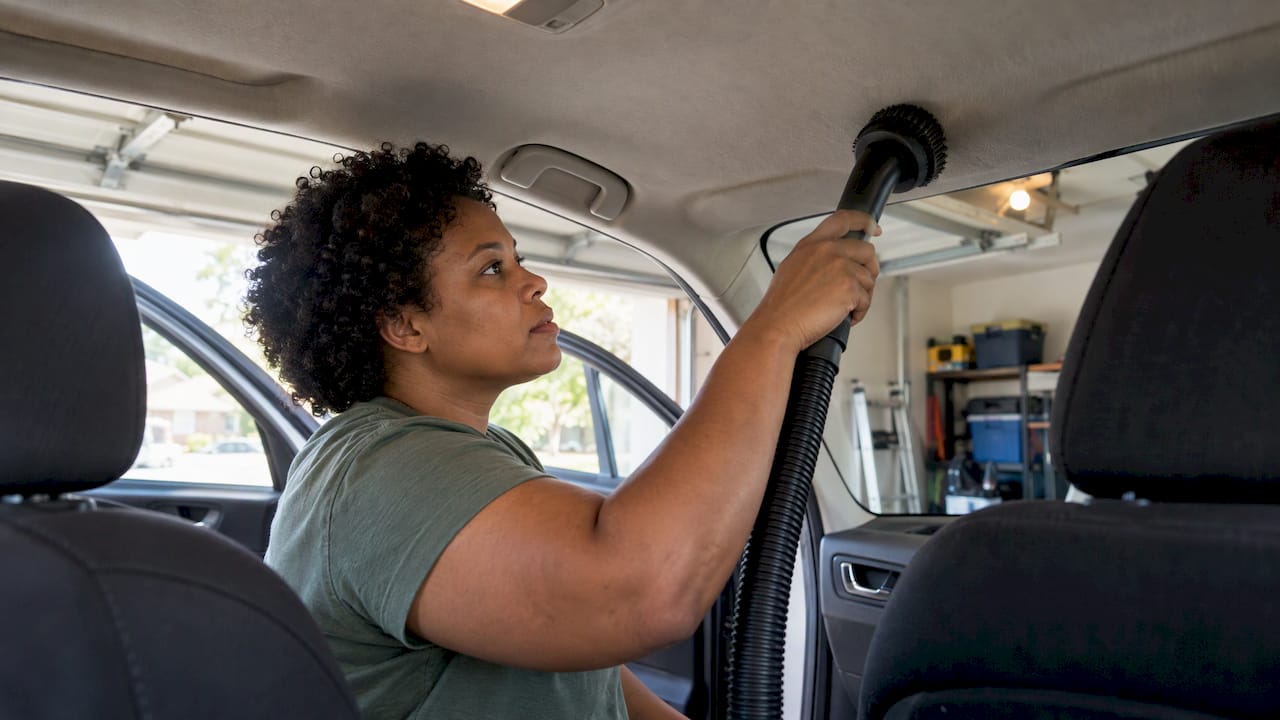
If the headliner is already stained brown from years of smoke, this is one place where a professional is worth it: a sagging headliner is expensive to fix.
4. Wipe the hard surfaces and the glass
Use an automotive interior cleaner on the dash, door panels, console, steering wheel and trim, and clean the glass inside and out. Hard surfaces generally clean up completely and do not hold odor long term. Do not forget the seat belts and their webbing, which absorb smoke. Pull the belt all the way out, wipe it with a lightly dampened cloth and let it dry fully before it retracts.
5. Clean the seats and carpet with the right product
Match the cleaner to the material. AutoZone recommends a dedicated automotive fabric cleaner for cloth and an appropriate leather cleaner for leather. It warns that too much cleaner creates moisture and can cause permanent staining, so work in thin passes. A wet/dry vacuum or extractor pulls out dissolved residue instead of pushing it deeper into the foam.
For leather, go lightly. Spot-test first, avoid soaking the surface, and read the four-step leather seat cleaning guide before you start. For fabric seats with stains on top of the smoke smell, the material-first stain removal guide helps you avoid setting them in.
6. Replace the cabin air filter and treat the HVAC
This is the step that decides whether the smell comes back. AutoZone explains that an old cabin air filter recirculates trapped smoke through the vents, which can make the problem seem worse. If you cannot see light through the filter, replace it, and consider replacing it even if it looks fine. It is usually behind the glovebox or under the dash, and your owner’s manual shows where.
After the new filter goes in, a foaming or mist HVAC cleaner is typically sprayed into the intake vents at the base of the windshield while the fan runs and air recirculates. Follow the product label exactly. Where it goes wrong: skipping the filter swap and treating only the vents, so the old filter keeps feeding smoke back into the cabin.
7. Use odor absorbers last, not first
Baking soda sprinkled on dry seats and carpet, left for a few hours or overnight and then vacuumed, pulls odor out of fabric fibers. An open box or a bag of activated charcoal left in the car for a day or two can absorb what remains in the air. These suit light to moderate smells and work as a finishing step after cleaning, not as a substitute for it.
What ozone treatment does, and why it needs a professional
Ozone is a gas that breaks down odor molecules and reaches into foam padding and ductwork that sprays cannot. Detailers use ozone generators on cars that still smell after a thorough cleaning. It is not a first step. Ozone on a car that has not been cleaned first tends to bring the odor back as the gas dissipates, because the residue is still there.
The safety side matters. The EPA explains that ozone generators sold as air cleaners intentionally produce ozone, and that studies show concentrations can exceed health standards even when the manufacturer’s instructions are followed. In practice:
- Never sit in the car, and never let a child or pet stay in it, while an ozone generator runs.
- Keep the car sealed during the treatment, then open all the doors and windows and let it air out fully before anyone gets in. Typical professional cycles run from about 30 minutes for light odors to 60 to 90 minutes for strong smoke, followed by ventilation.
- Do not run ozone in a garage attached to your home.
Because of these risks and because getting the sequence right takes experience, ozone is best left to a trained detailer. The same goes for other strong chemical work. A pro knows how to seal the cabin, control the exposure and ventilate afterward.
Home remedies: what to skip
Some popular tips are risky for your interior or simply do not work:
- Vinegar on leather or headliners. Diluted white vinegar is a common suggestion for hard surfaces and some fabrics, but it is not a replacement for a proper automotive cleaner, and soaking leather or a headliner invites staining, warping or sagging. Spot-test and use sparingly, if at all.
- Coffee grounds, citrus peels and dryer sheets. These can hide a smell for a while. They do not remove residue.
- Perfumed sprays and hanging trees. They only disguise the odor for a day or two.
- Steam without extraction. Steam can help loosen residue, but you have to pull the moisture back out. The dry-vapor steam guide explains why extraction after every pass matters.
Also watch for dampness. If a seat or carpet stays wet after cleaning, you can trade a smoke problem for a mold problem. If you see or smell mustiness, the mold removal guide explains why acting within 48 hours matters.
DIY or professional: how to decide
Do it yourself if:
- The smell is mild or the car was only smoked in occasionally.
- You have a wet/dry vacuum, the right cleaners and a free weekend.
- The headliner is clean and firmly attached.
Hire a professional if:
- The smell has been there for years or the car was smoked in daily.
- The headliner is stained, discolored or already sagging.
- You have cleaned twice and the smell is still there. The car odor removal guide covers the safe steps to try and what pros do after two unsuccessful cycles.
- You want ozone or enzyme treatment, or you are getting the car ready to sell.
- You are short on time and want it handled where the car is parked.
Cost depends on the severity, the size of the vehicle and your area. For a general sense of what interior detailing runs across the U.S. and what to check before you book, see the interior detailing price guide and buyer checklist. Smoke jobs usually cost more than a standard interior detail because they take more passes and more time, so ask each detailer to price your specific car.
Questions to ask a detailer before you book
A good smoke removal job starts with a clear conversation. Ask:
- Will you inspect the car, or look at photos, before quoting?
- Do you replace the cabin air filter and treat the HVAC system?
- How do you clean the headliner without making it sag?
- Do you extract the seats and carpet, and do you use ozone or enzyme treatment afterward?
- How long will the car be with you or at your location, and could it need a second visit?
- What result is realistic for my car’s age and how long it was smoked in?
A detailer who answers these plainly, and who explains what might need replacing in a worst-case car, is a good sign.
Find a mobile detailer for smoke odor
MobileDetailing.io is a nationwide directory of local mobile detailing professionals. You search by location, compare businesses that offer interior detailing and full-service detailing, and send a quote request. It is free for vehicle owners. Because mobile detailers come to your home or workplace, you do not have to give up the car for a day to get it done. Listings include services, photos and reviews, so you can see who handles interior work in your area. You can browse local pages such as interior detailing in Detroit, MI, or go straight to a local quote request and describe the smoke situation so detailers can price it accurately.
When you write your request, include how long the car was smoked in, whether the headliner looks stained, whether the vents smell when the fan is on, and whether you want the work done at home or the office.
How to keep the smell from coming back
If the car was cleaned properly, a returning smell usually has one of three causes:
- Foam still saturated. Only the surface was cleaned, while the padding underneath still holds residue.
- The cabin filter was not replaced. The old filter keeps releasing odor.
- Heat. Hot weather can make leftover residue off-gas. This is why checking on a warm day is smart.
If you or a passenger still smoke in the car, Car and Driver suggests setting the A/C to pull in outside air instead of recirculating, keeping the windows open, and using a covered ashtray cup. That reduces how much smoke settles on the interior, but it will not keep a car smelling like new. Replace the cabin filter on schedule, and wipe hard surfaces regularly so residue does not build up.
FAQ
Can you fully remove smoke smell from a car?
In most cases, yes. Light and moderate smoke usually cleans up completely with a thorough interior cleaning, a new cabin filter and an HVAC treatment. Cars smoked in for many years may keep a faint trace in seat foam or the headliner, and in rare cases those parts need replacing.
How long does it take to get smoke smell out of a car?
A careful DIY job often takes a full day, plus airing time and a day or two for absorbers like baking soda or charcoal. A professional visit for a heavy case can take most of a day, and severe cars sometimes need a second visit. A detailer can estimate after seeing the car.
Does baking soda really remove cigarette smell from a car?
Baking soda absorbs odor from fabric and air rather than covering it, so it helps with mild smells when left for several hours or overnight and then vacuumed. It will not reach foam padding or the HVAC system, so it works best as a finishing step after cleaning.
Is it safe to use an ozone generator in my car myself?
The EPA warns that ozone generators can produce concentrations above health standards even when used as directed, so nobody should be in the car during treatment and it must be aired out fully afterward. Because of this and because the car must be cleaned first, ozone is usually best handled by a trained detailer.
Sources
- Hagerty: How to Remove Gross Cigarette Odors from Your Car’s Interior
- Car and Driver: How To Get Smoke Smell Out of the Car
- AutoZone: How to Remove the Smoke Smell Out of Your Car
- EPA: Ozone Generators that are Sold as Air Cleaners
- Low-moisture car headliner cleaning method
Recommended
- Car Odor Removal: Safety First DIY Steps Pros Use After Two Cycles
- Act Within 48 Hours: Safe Car Interior Mold Removal, DIY or Vetted Pro
- Home Detailers: Dry Vapor Steam Car Interiors, Extract After Every Pass
- How to Remove Pet Hair From Your Car, Plus Winter Salt
MobileDetailing.io provides general educational information. Products, surfaces and vehicle finishes vary. Follow manufacturer instructions and consult a qualified detailing professional before using abrasive processes or chemical treatments.