Orange Peel Removal: How It Works and Who Should Do It
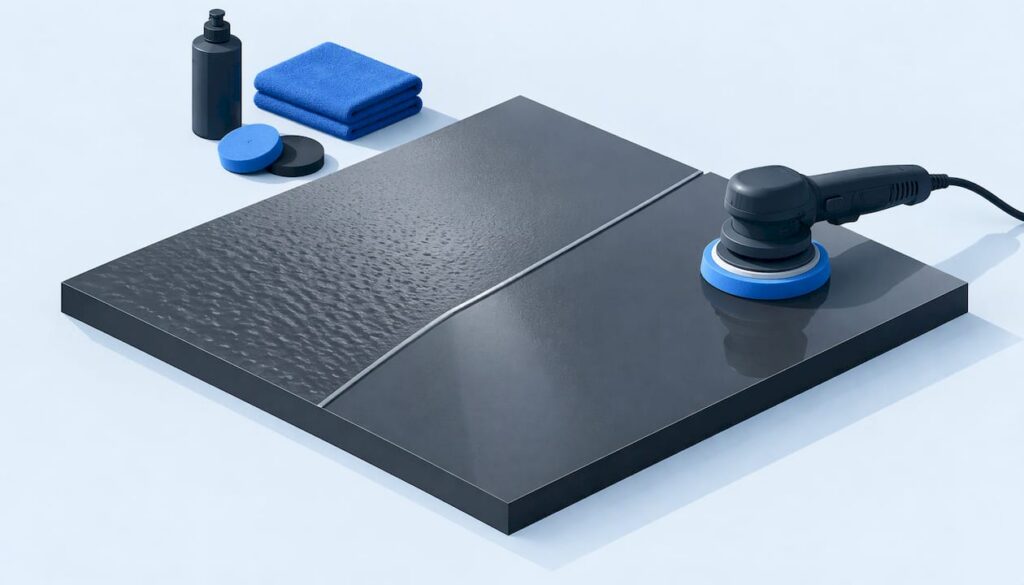
Orange peel removal is a leveling job: a detailer shaves the high points of the clear coat down to the low points, then polishes the surface back to gloss. Because that work permanently removes clear coat, the safest route for most owners is a paint correction professional who measures the film first. On MobileDetailing.io you can search by location for mobile detailers who offer paint correction and request a quote at no cost to you.
This guide explains what orange peel is, how to tell whether it can be corrected, what the process looks like step by step, and when a respray is the better answer.
Table of Contents
- What orange peel is and why it shows up
- Is it really orange peel?
- The question that decides everything: how much clear coat is left?
- How professionals remove orange peel, step by step
- Can orange peel be reduced without sanding?
- When respraying is the better choice
- Why a professional is the right call for most owners
- How to find a paint correction pro near you
- Get a quote for orange peel correction
- Frequently asked questions
- Sources
What orange peel is and why it shows up
Orange peel is a bumpy, dimpled texture in the paint that looks like the skin of an orange. Under a streetlight or a flashlight held at a low angle, reflections look wavy instead of sharp. Instead of a flat, glassy surface, the clear coat has tiny hills and valleys.
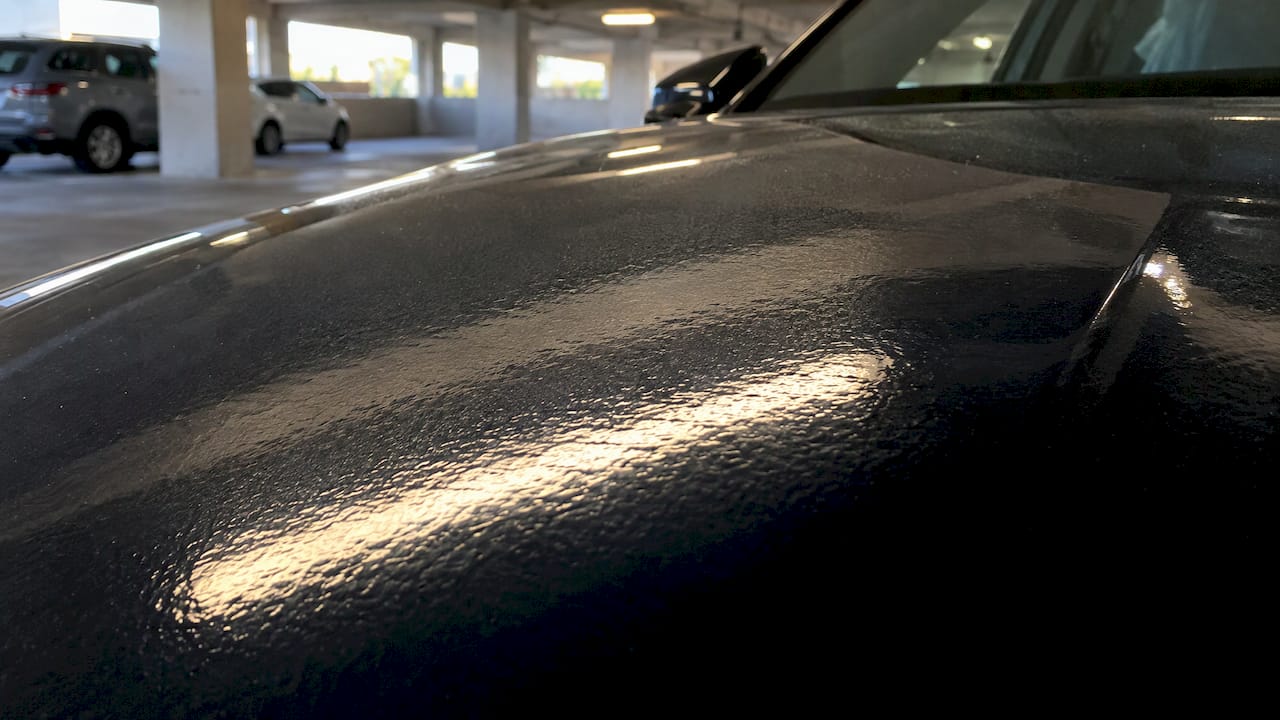
It starts at the paint booth. A paint manufacturer’s troubleshooting guide lists the usual causes: paint that was not thinned enough, low air pressure, a fast-evaporating reducer, heavy coats, a poorly set up spray gun and spraying technique. In plain terms, the paint did not have time or the right conditions to flow out flat before it dried.
That is why orange peel is common on repainted panels. A body shop explains how spray application and curing conditions can leave uneven texture in the clear coat. It is also found on factory finishes. A detailing-products educator, Mike Phillips, says in an interview that orange peel is a natural byproduct of factory painting, and that factory finishes carry about as little clear coat as the manufacturer can get away with.
The takeaway for you: a bit of texture is normal. Whether to remove it is a matter of taste, and whether you can remove it depends on how much clear coat is there to work with.
Is it really orange peel?
Before anyone talks about sanding, the panel needs a proper look. Several other problems resemble orange peel, and they need different fixes.
- Wash and decontaminate first. Bonded dirt and overspray can feel rough like texture does. A shop blog notes that defects that disappear after decontamination are not orange peel. Washing in the right order also keeps grit from scratching the paint during inspection; this wash sequence that keeps grit off paint is a good model.
- Look in raking light. A car-care brand describes inspecting the panel under direct, low-angle light for small-scale waviness, then feeling the surface: orange peel is rougher than flat, glassy paint.
- Rule out pits and craters. Small circular craters point to other defects, such as solvent pop or fisheyes, according to the same shop guide. Those are not leveled out with the orange peel process.
- Confirm it is in the clear coat. The texture has to be in the clear layer, not the color coat beneath. An auto body training resource warns that sanding the base coat will not fix the texture and can ruin the finish.
A good detailer does this inspection at the start of an appointment. If you are collecting quotes, describe what you see and send photos taken in angled light.
The question that decides everything: how much clear coat is left?
Orange peel removal does not repair paint. It removes the high points of the clear coat so the surface reads as flatter. That means the job always costs you some of the protective layer, and the clear coat on a car is thin to begin with.
The number that matters comes from a paint thickness gauge, a handheld tool that reads film thickness in mils (thousandths of an inch). One collision training source cites GM as indicating that factory clear is typically 1.5 to 2 mils and says removing more than 0.5 mil risks premature coating failure. That is a body-shop reference, not an official GM bulletin, so treat it as a rough guide. It still shows how little margin there is.
A few situations narrow that margin further:
- Edges and body lines. Paint is thinner at edges, and a hobbyist guide warns that sanding there risks burn-through. Burn-through means sanding through the clear into the color coat.
- Unknown paint history. If the car has been repainted or polished heavily before, you do not know what is left. A paint-pad maker advises using its orange peel pads only when you are sure the texture is in the clear coat, and to be careful near edges and body lines.
- Fresh paint. Sanding should wait until the clear coat is fully cured, and a small, hidden test spot with the least aggressive method comes first, as one technical guide puts it.
This is why measuring is the first step in any responsible job. A detailer without a gauge is guessing, and the cost of a wrong guess is a repainted panel.
How professionals remove orange peel, step by step
Here is what the process looks like when it is done carefully. It is described so you know what to expect from a pro, not as a weekend project: wet sanding, paint correction and hazardous-chemical work are jobs where mistakes are expensive and permanent.
1. Measure and map the panel
The detailer reads film thickness across the panel, including near edges, and decides whether leveling is safe. If the numbers are low, the right answer may be to leave the texture alone or refer the panel to a body shop.
2. Wash, decontaminate and mask
The surface is cleaned so no grit gets under the sandpaper. Edges, trim and sharp body lines are taped off, because they burn through first.
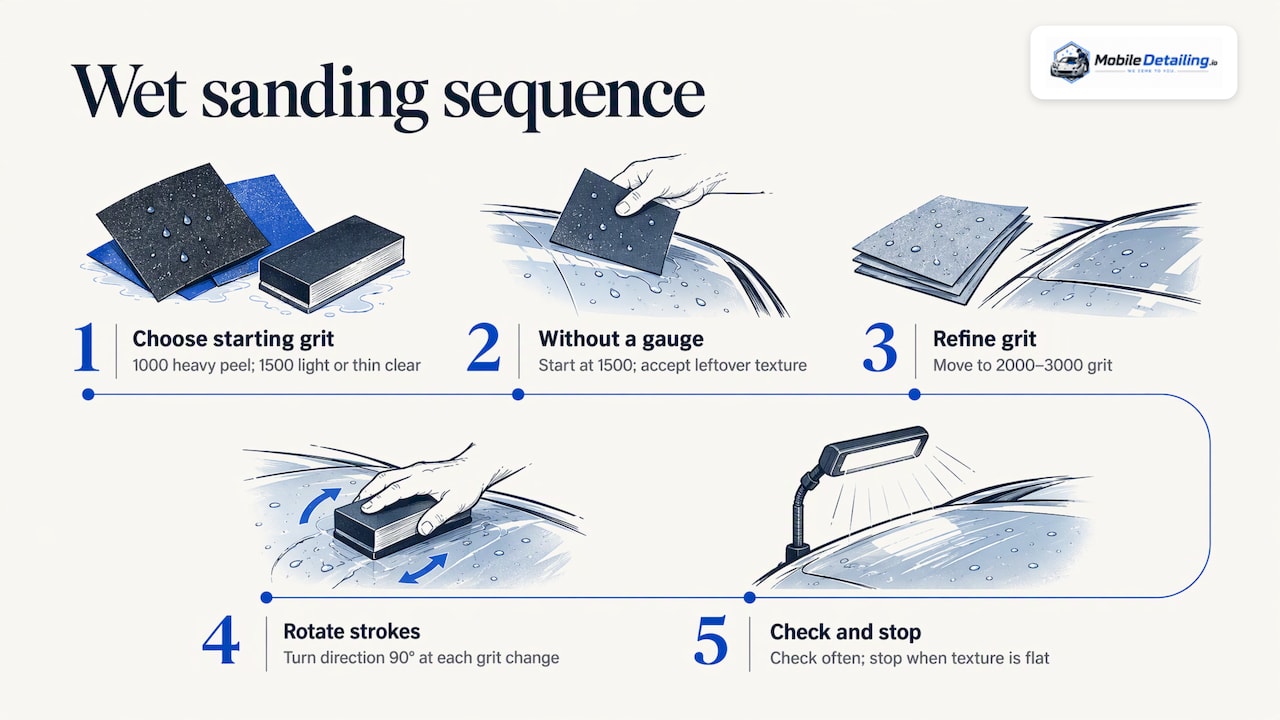
3. Wet sand with a soft block
Wet sanding uses very fine waterproof sandpaper with soapy water as lubricant. An abrasives maker’s guide describes the typical approach: a soft block, starting at 1000 grit for heavy peel or 1500 for light texture, then 2000 to 3000 grit, turning the stroke direction 90 degrees at each grit change.
Another abrasives supplier suggests 1500 then 2000 for thin clear, and a heavier start of 1000 for typical refinish work, with coarser grits reserved for heavy paint build. The same page says that without a gauge you should start at 1500 grit and accept some leftover texture rather than risk strike-through. Notice the pattern: every source treats the least aggressive option as the starting point.
A detailing-products company also stresses checking the surface often and stopping the moment the texture is flat. Further sanding adds nothing and just removes clear coat.
4. Compound and polish
Sanding leaves a uniform haze of fine scratches. A machine polisher with compound removes the sanding marks, and a finer polish brings back the gloss. This is the same logic behind the stages described in what 1, 2 and 3 stage paint correction really mean: each step refines the one before it.
5. Inspect, protect and recheck
The finish is inspected in raking light again, and the panel is measured once more. Because the freshly corrected clear coat is more exposed, many owners follow up with a wax, sealant or ceramic coating. If you are considering one, a detailer can quote it together with the correction.
Can orange peel be reduced without sanding?
Only slightly. The paint manufacturer’s troubleshooting guide says orange peel can be reduced by compounding or polishing, or sanded smooth with 1200-grit or finer paper and then compounded and polished. In practice, polishing alone mostly changes how the surface looks rather than flattening it. A detailing wiki puts it this way: polishing has little effect on the texture itself, though some special pads act like a fine sanding step.
So a polish can make very light texture look a bit better and bring back gloss, but real leveling needs abrasive work. If a detailer offers “no sanding” orange peel removal, ask what the method does to clear coat thickness and what they expect the result to look like.
When respraying is the better choice
Sometimes leveling is the wrong call, and a good professional will say so. A respray makes sense when:
- the texture is in the base coat rather than the clear;
- the clear coat is already at its minimum thickness;
- the peel is heavy enough that flattening it would take off more clear than the manufacturer’s limits allow.
That list comes from the same collision training source. A detailing shop blog adds that the main sanding risk is burn-through, which forces a full panel repaint. The same sources say to avoid sanding when paint history is unknown or the clear is thin or failing.
Respraying is a body shop job. A detailer who measures honestly can tell you which path your car needs, and that candor is worth more than a promised mirror finish.
Why a professional is the right call for most owners
The case for hiring comes down to three points.
The process is permanent. You cannot put clear coat back. Experts across the research all describe the same loop: measure, sand a little, check, stop when flat. That discipline, plus a gauge and a soft touch around edges, is what you are paying for.
The cost of a mistake is a repaint. One slip near a body line can mean refinishing the whole panel, which costs far more than the correction would have.
It is convenient. Mobile detailers bring the equipment to your driveway or office. Paint correction needs good lighting, clean water and power, and a mobile pro will tell you in advance what the setup requires. That suits busy professionals, families and fleet managers who cannot leave a vehicle at a shop for days.
This applies to more than daily drivers. Owners of exotic, luxury and classic cars, often with unknown or thin paint, are the readers who gain the most from a measured, conservative approach. Boat, RV and aircraft owners dealing with oxidized or textured gelcoat and paint should look for a detailer who works on that specific surface type.
How to find a paint correction pro near you
Mobiledetailing.io is a nationwide directory of local mobile detailers. Vehicle owners search, compare and request quotes for free. You can search by city, then look at each business’s services, photos and reviews. Listings that mention paint correction, such as Mirror Finish Detailing and Paint Correction in Hickory, NC, Next Level Paint Correction & Coatings in Tuscaloosa, AL and Supreme Shine Auto in Anaheim, CA, show what the category looks like. Browse your own area for the closest options.
When you contact a detailer, give them what they need to judge your paint:
- Photos of the panels in angled light, plus the car’s year, make and model.
- Whether any panel has been repainted, and when.
- What you want: a flatter look on one hood, or the whole car.
- Whether you plan to add a coating afterward.
Useful questions to ask in the conversation:
- Do you measure paint thickness before correcting? What would make you decline a panel?
- Which panels or areas would you avoid, and why?
- What finish should I realistically expect, given my paint?
A detailer who answers these clearly, and who is willing to leave texture in place to protect the clear coat, is thinking about your paint’s future.
Get a quote for orange peel correction
Mobiledetailing.io lists mobile detailers who offer exterior detailing, paint correction and ceramic coating, and it is free for vehicle owners. Describe your car and your paint on the quote request page, and local professionals can respond with what they would do. If you want to start by comparing businesses, begin at the MobileDetailing.io home page and search your location.
Frequently asked questions
Can orange peel be removed completely?
Usually it can be reduced a lot, but not always eliminated. A detailing wiki notes that orange peel is nearly impossible to prevent entirely, and how flat the finish gets depends on how much clear coat you can safely remove. A detailer who measures your paint can tell you how far the correction can go.
Is orange peel on a new car normal?
Yes, a degree of it is. Factory painting leaves some texture, and the clear coat is kept thin, so a new car is often a poor candidate for aggressive leveling, as Mike Phillips explains. If the texture bothers you, ask a paint correction pro to measure before deciding.
Is wet sanding something I should try myself?
We recommend professional help for wet sanding and paint correction. It permanently removes clear coat, and a mistake near an edge can mean repainting the panel. Detailers who do this work regularly bring a thickness gauge, trained judgment and a plan for stopping at the right point.
How do I find a mobile detailer who does paint correction?
Search your city on MobileDetailing.io, review each listing’s services, photos and reviews, and send a request through the local quote page. Include photos of the paint in angled light and any repaint history so the detailer can judge the panel before the visit.
Sources
- Troubleshooting Guide, Sherwin-Williams Automotive
- Clear Coat Repair: Causes, Process and When to Respray
- Car Wash Sequence: Keep Wheel Grit Off Paint
- Orange Peel Car Paint Causes: Fix Rough Clear Coat
- Orange Peel Car Paint: Causes, Identification, And Fixes
- Orange Peel: Sand and Buff It or Respray?
- Talking Orange Peel with Mike Phillips
- How to Remove Orange Peel from Car Paint
- CARPRO Denim Orange Peel Removal Pad
- Fix Rough Paint Texture Without Repainting: A Guide
- Wet Sanding Explained: Paper, Grits and Technique
- Remove Auto Orange Peel Safely: 1000–2000 Grit Guide
- Wet Sanding 101: When to Use It and How to Avoid Disaster
- Wet Sanding vs. Machine Polishing
- What is orange peel, DetailingWiki
Recommended
- Boat Owners: 3-Tier Gelcoat Oxidation Removal Plan to Avoid Overcutting
- Stop Before You Strip Clear Coat: Clay First Car Overspray Removal
- Fix Sap Before It Etches: Safe Sap Removal for U.S. Car Paint
- Preserve Clear Coat While Removing Ceramic Coating, Verify With IPA
MobileDetailing.io provides general educational information. Products, surfaces and vehicle finishes vary. Follow manufacturer instructions and consult a qualified detailing professional before using abrasive processes or chemical treatments.