Mobile Detailing No-Show Policy: Fees, Notice and Fair Terms

A fair mobile detailing no-show policy answers four questions before you book: how much notice you need to give, what happens to your deposit, how long the detailer waits at your location, and what fee applies if the job can’t happen. Published policies from U.S. detailers cluster around 24 to 48 hours of notice, with fees ranging from a flat $50 to the full service price. Read the policy first, confirm it in writing, and a missed appointment becomes easy to avoid. If you are a detailer, the same four answers are the backbone of the policy you should publish.
If you are still choosing a pro, MobileDetailing.io lets you search by location and compare detailers for free. You can send your details through the local quote request and see each business’s terms before you commit.
Table of Contents
- What counts as a no-show in mobile detailing
- What U.S. detailers actually charge
- What a fair policy should say
- If you’re booking: how to avoid a fee
- If you’re a detailer: writing a policy that works
- Different services, different risk
- Finding a detailer whose terms fit you
- FAQ
- Sources
What counts as a no-show in mobile detailing
In a shop, a no-show means the customer never arrives. Mobile detailing is different because the detailer drives to you. Time, fuel and a blocked-off slot are spent before anyone touches the car, so the definition is wider.
Most policies treat these situations as a no-show or a late cancellation:
- No response at arrival. Nobody answers the door, phone or text when the detailer pulls up.
- No access to the vehicle. The car is locked with no keys, parked behind a locked gate, or moved somewhere else. Boise Mobile Auto Detailing treats missing gate codes, no vehicle access or no one available to authorize entry as a late cancellation, with a possible travel and scheduling fee.
- No water or power. Many mobile detailers need a spigot or an outlet. GoDetail’s terms allow a fee of up to 100% of the service total, capped at $199, when required water or electricity access is missing.
- Cancelling inside the notice window. This is usually called a late cancellation, and it often has its own fee, lower than the no-show fee.
- Arriving very late. Some policies set a grace period. Infinite Detailing’s terms give customers 10 minutes after arrival before the appointment counts as a no-show.
The point of splitting these cases is fairness. A customer who calls the evening before to move an appointment costs the detailer less than a customer who is not home when the van arrives. A good policy prices them differently.
What U.S. detailers actually charge
There is no standard fee. Each business sets its own, and the amounts below come from the businesses’ own published agreements. They show the range, not a price you will necessarily pay.
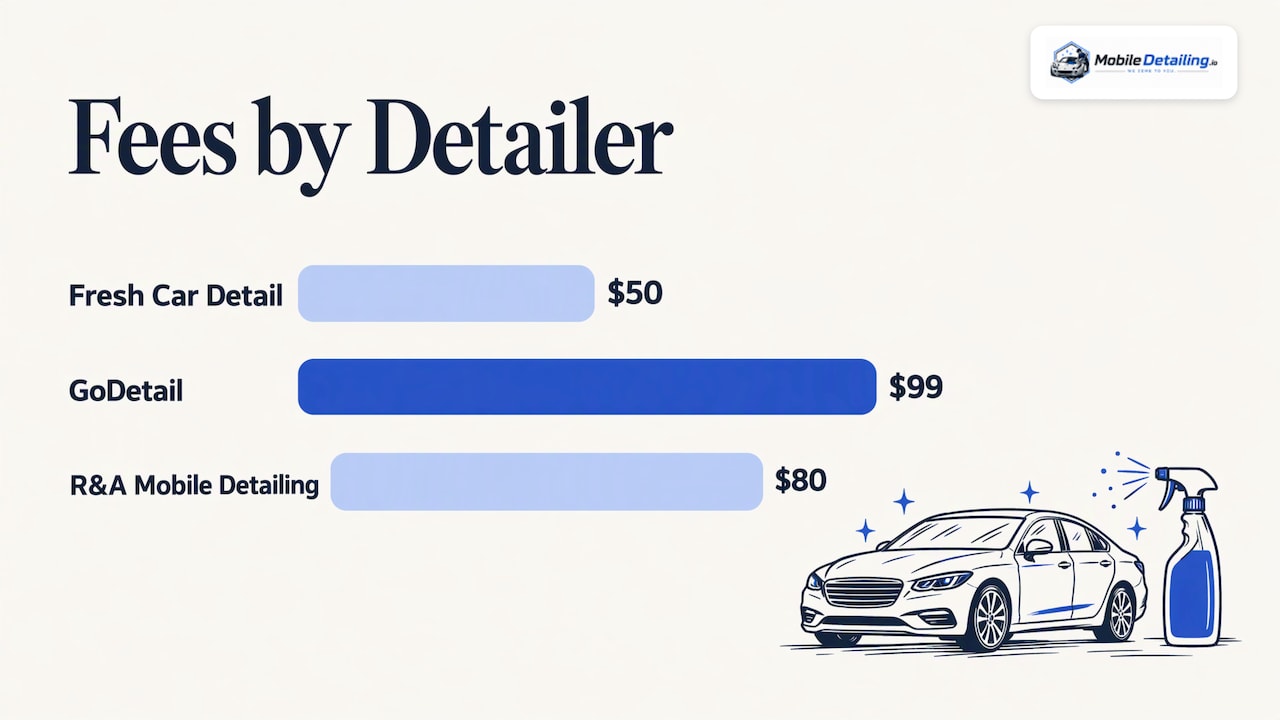
| Detailer | 48+ hours’ notice | 24 to 48 hours | Under 24 hours | No-show |
|---|---|---|---|---|
| Fresh Car Detail | No fee | $50 | 50% of service (up to $250) at 12 to 24 hours | 100% of service, up to $250 |
| GoDetail | No fee | $99 | Up to $199 | Up to $199 |
| R&A Mobile Detailing | Not listed | $80 | $150 | Up to $250 (full service amount) |
| Infinite Detailing | No fee | Full appointment amount for non-committed customers under 48 hours | Full appointment amount | Full appointment amount |
The pattern is consistent. Free changes with plenty of notice, a modest fee as the date gets close, and a larger fee, often capped, when the detailer shows up and cannot work. Caps matter to customers. A $250 ceiling on a full-detail price means a large ceramic coating booking does not carry a four-figure penalty for a missed slot.
Deposits work differently. Some businesses collect a deposit and apply it to the final bill; others keep it when you cancel late. Both are common, so the question to ask is simple: is my deposit refundable, transferable to a new date, or forfeited, and at what cutoff?
What a fair policy should say
Whether you are a customer judging a policy or a detailer writing one, the same checklist applies. A fair policy states, in plain words:
- The notice window. For example, 24 or 48 hours before the start time. FindLaw’s overview notes that businesses can generally set exact cancellation windows, often 24 or 48 hours, and non-refundable deposits, subject to state laws that may limit unreasonable charges.
- The fee at each stage. A flat amount or a percentage of the service, and any cap.
- The deposit outcome. Whether it is applied to the bill, carried to a new date, or kept.
- The grace period. How long the detailer waits and how they will try to reach you first.
- Rescheduling rules. How many reschedules are allowed. Infinite Detailing, for example, allows one reschedule per appointment with the new date within 10 days.
- Access requirements. Gate codes, keys, water and power, and a parking spot where the work can legally and safely happen.
- Who can approve exceptions. Emergencies happen. A clear exception rule keeps two customers in the same situation from being treated differently.
Where the policy appears matters as much as what it says. It should be visible before you confirm, not buried. The Federal Trade Commission has treated hidden fee disclosures as a problem: in a 2015 complaint, it alleged that a small, inconspicuous hyperlink disclosing a cancellation processing fee was deceptive. That case involved a different industry, but the principle carries over: a fee you were never clearly shown is a fee worth questioning.
If you’re booking: how to avoid a fee
Most no-show charges are avoidable. They usually come from a locked gate, a forgotten appointment or a last-minute change, not from bad intent.
Before you book
- Read the cancellation terms on the detailer’s site or listing, and note the notice window and fee.
- Send your request through the MobileDetailing.io quote form and mention the vehicle, location and preferred time. Use the reply to confirm the date, the arrival window, and the cancellation terms in writing.
- Check that you can give the detailer what they need on site: access to the car, a water source, and an outlet if the detailer lists that as a requirement.
In the days before
- Put the appointment in your calendar with a reminder the day before.
- Reply to confirmation texts. If you can’t make it, say so as early as you can. A change made 48 hours out is often free; the same change made on the morning of the job is where fees begin.
- Send gate codes, building instructions and parking details ahead of time, especially for workplace and apartment bookings.
On the day
- Keep your phone nearby. Many policies start a grace period when the detailer arrives and tries to reach you.
- Leave the keys accessible if you won’t be there, as agreed with the detailer.
If you do get charged and think it is wrong, compare the charge against the terms you accepted. Ask the business for the policy you agreed to and the timeline of messages. A fee that matches terms you were shown is hard to dispute. A fee that was never disclosed is a fair thing to raise with the business, and if you can’t resolve it, with your card issuer or your state attorney general’s consumer protection office.
Does the three-day cooling-off rule apply?
Probably not. The FTC’s Cooling-Off Rule gives buyers three business days to cancel certain sales made away from the seller’s place of business. But the rule does not apply when the buyer specifically asked the seller to visit for repair or maintenance of personal property. A mobile detailing visit you requested falls into that situation, so the detailer’s own cancellation terms are what govern.
If you’re a detailer: writing a policy that works
Mobile detailers lose more than a slot when a customer disappears. They lose the drive time and the chance to book that window with someone else. A policy is how you price that risk fairly. These are the building blocks that appear across published detailer agreements.
Pick a notice window and tiers
Two or three tiers are enough. Free at 48 or more hours, a lower fee at 24 to 48 hours, and a higher fee under 24 hours is a structure several detailers use, as the table above shows. Keep the fee in proportion to the loss. Payment guidance for service businesses suggests sizing deposits to the job, for example a flat amount for a short appointment and a percentage for a multi-hour booking. Whatever you choose, put the number in the policy in dollars or as a percentage, never “a fee may apply.”
Take a deposit on bigger jobs
A deposit turns a casual booking into a commitment. It matters most for expensive, long or hard-to-refill jobs such as paint correction or ceramic coating, where one cancelled day leaves a large hole in the schedule. Decide before you collect whether the deposit is applied to the final bill, carried to a new date if the customer gives enough notice, or kept on a late cancellation or no-show. State all three.
For work like ceramic coating or paint correction, customers expect to commit in advance, so a deposit rarely surprises them if it is explained at booking.
Get active agreement, not fine print
If you plan to charge a card on file, the customer should actively accept the terms, for example by ticking a box, and the policy should say what triggers a charge. The FindLaw guidance above points to state law as the limit on unreasonable charges, and some states, including California and New York, add their own consumer-protection rules. Have a local attorney review your terms for your state before you rely on them. Courts in general look more kindly on a fee that reasonably reflects your actual loss than on one that reads as a punishment.
Confirm and remind
Reminders reduce no-shows, and the evidence is clearest in healthcare. A 2016 randomized trial of appointment reminders found that adding a text message to a voice reminder lowered no-shows from 38.1% to 23.5%, as summarized by a texting-reminder guide. That was a medical setting, so treat it as a sign that reminders work, not a promise for detailing. If you text customers, get their consent first, include a way to opt out in each message, and follow the carrier registration rules for business texting that apply to you.
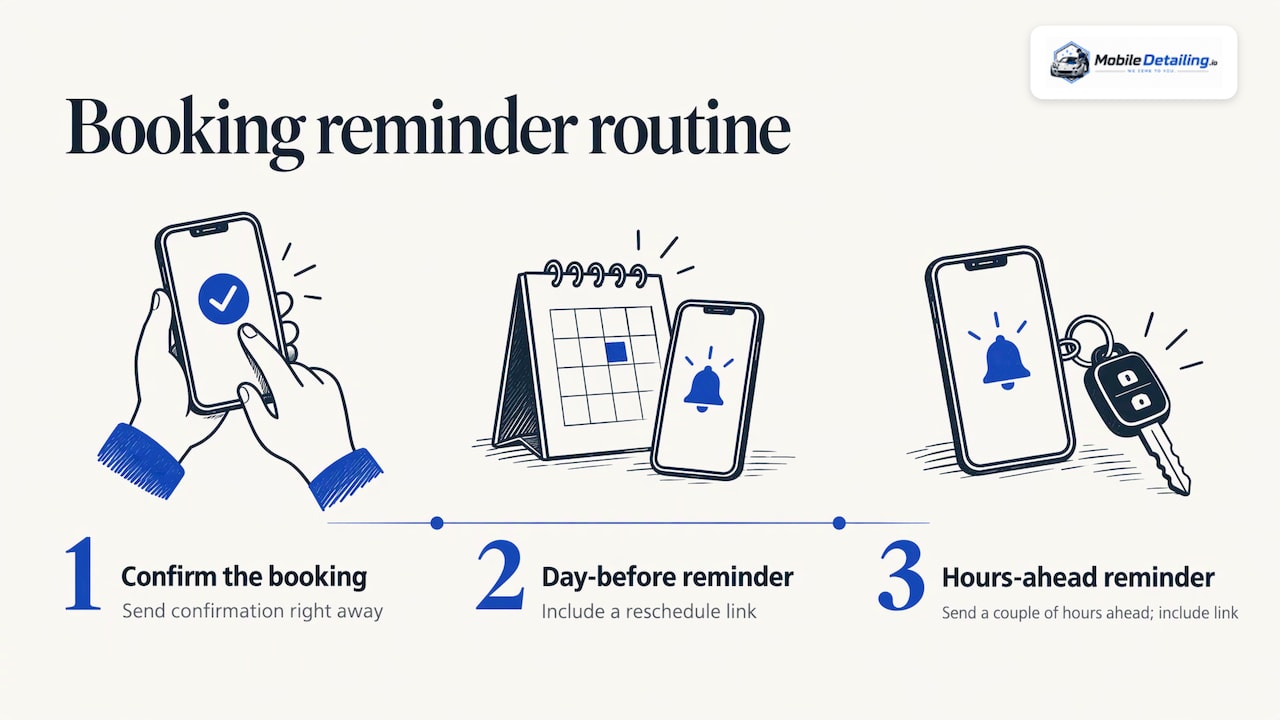
A simple routine many detailers use: confirm the booking right away, send a reminder the day before and another a couple of hours ahead, and put a reschedule link in each one. Making it easy to move an appointment turns some would-be no-shows into rebookings, which is better for you than an empty slot.
Handle the day-of no-show the same way every time
- Call or text the customer as soon as you arrive.
- Wait the grace period stated in your policy, commonly 10 to 15 minutes, and take a timestamped photo of the location.
- Apply the policy as written and note it in the customer’s file.
- Follow up politely. Many no-shows are mistakes, and a friendly message often brings the customer back to rebook.
Consistency is what makes a policy fair. If you waive a fee, write down the reason. If a customer misses repeatedly, it is reasonable to require full prepayment on future bookings, as some businesses state in their booking terms.
Keep records
If a customer disputes a charge, you will want the accepted terms with a timestamp, the reminder messages, your attempts to reach them and the arrival photo. Check the agreed fee, the cancellation condition and your permission to charge together before you collect anything. If you cannot find the terms the customer accepted, hold off on the charge.
Follow up on quote requests
Many no-shows start with a slow, vague booking process. A prompt, clear reply that restates the date, price and terms keeps customers committed. MobileDetailing.io’s own guide to following up on detailing leads lays out a three-day routine for quote requests.
Different services, different risk
The same policy does not fit every job.
- Interior and exterior details at home or work: the main risks are access and parking. Emphasize gate codes, keys and a water source.
- Ceramic coating and paint correction: the work takes hours or days and the schedule is hard to refill, so deposits and longer notice windows are common. Professional help is the right call for coatings and paint correction in any case.
- Boats and marine detailing: access depends on the dock, marina rules and tides or weather. Ask how a weather delay is handled and whether it counts as a cancellation. Browse marine detailers to see how listed businesses describe their services.
- Aircraft and helicopters: hangar access and airport security can block a visit. Confirm who needs to be present and what happens if clearance is delayed.
- Fleets and rideshare drivers: recurring schedules benefit from one agreed policy that covers the whole route, including who authorizes entry when the driver is not there.
Weather deserves its own line in any mobile policy. DetailPropos’s template includes a weather card among its six policy sections, alongside notice tiers, no-show and late arrival rules.
Finding a detailer whose terms fit you
A policy is one piece of choosing a mobile detailer, alongside service type, location, photos and reviews. MobileDetailing.io is a nationwide directory where vehicle owners search by location and compare businesses that offer interior and exterior detailing, ceramic coating, paint correction, window tinting, and services for cars, boats, RVs, motorcycles and aircraft. It is free for vehicle owners. When you find a few candidates, request a local quote and use the replies to compare availability and terms side by side.
If you run a detailing business, you can add or claim a listing, receive quote requests and use the platform’s tools to show your services, photos and reviews, which is a good place to link your published policy so customers see it before they reach out.
FAQ
What is a no-show fee in mobile detailing?
It is a charge when you aren’t available or the vehicle can’t be accessed when the detailer arrives. Published amounts range from a flat $199 or $250 cap to 100% of the service price, depending on the business. The fee should be in the terms you accepted before booking.
How much notice do I usually need to cancel?
Most published agreements use 24 to 48 hours. Several detailers charge nothing at 48 hours or more, a smaller fee between 24 and 48 hours, and a larger one inside 24 hours. Check your detailer’s own terms, since they set the window.
Can a detailer charge me if I never saw the policy?
A fee is much easier to defend when you were shown and accepted it before booking. If you were never shown the terms, ask the business for a copy and the record of what you agreed to. Rules vary by state, so contact your state attorney general’s consumer protection office if you can’t settle it.
How can I reduce no-shows as a detailer?
Confirm every booking, send reminders with a reschedule link, take deposits on larger jobs and state your fees clearly at booking. Then apply the policy the same way each time. Reminders and easy rescheduling help most customers keep the appointment or release the slot in time for someone else.
Sources
- Cancellation Policy, Boise Mobile Auto Detailing
- Terms & Conditions, Infinite Detailing
- Service Agreement, R&A Mobile Detailing
- Service Agreement, Fresh Car Detail
- Service Agreement, GoDetail
- FindLaw: Can Businesses Charge Appointment Deposits and Cancellation Fees?
- FTC complaint, 2015
- FTC Cooling-Off Rule, Federal Register, 2015
- SMS reminders and no-show reduction
- No-show and cancellation policy template
MobileDetailing.io provides general educational information. Products, surfaces and vehicle finishes vary. Follow manufacturer instructions and consult a qualified detailing professional before using abrasive processes or chemical treatments.