Referral Program Ideas for Mobile Detailers That Fill the Calendar
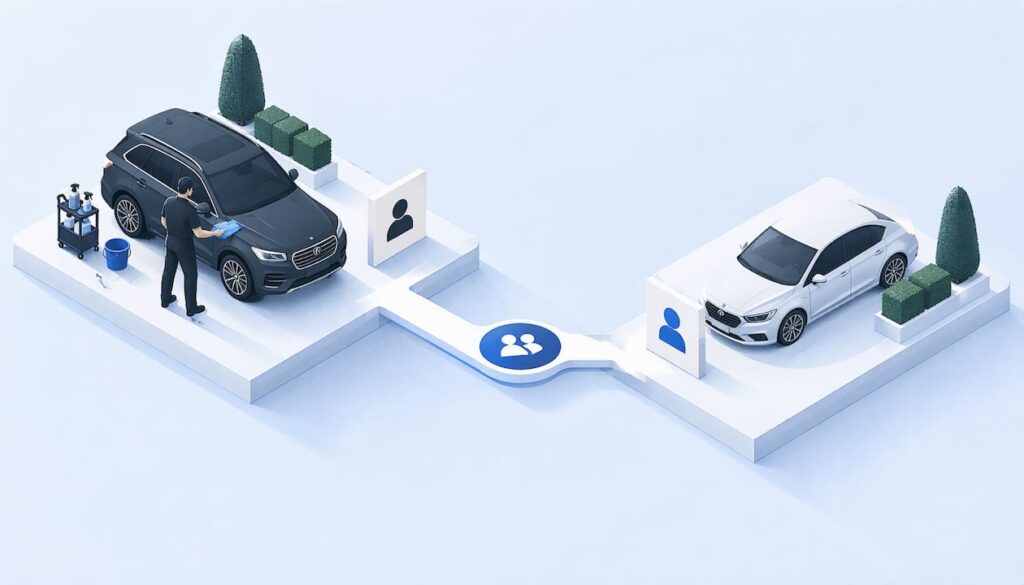
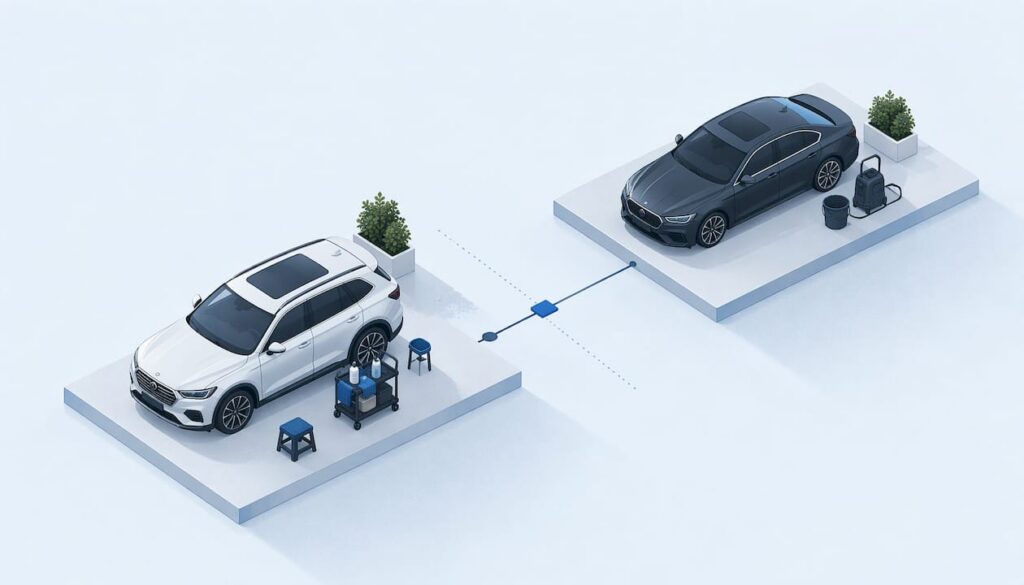
The referral program that works best for a mobile detailer is a simple two-sided offer. The customer who refers gets a credit toward their next detail, and the friend gets a discount on a first booking. Pay out only after the new job is done. Ask at the moment a customer is looking at a clean car, and give them something to hand over: a link, a code or a printed card.
That is the core. The rest of this guide covers which reward fits which service, how to ask, how to track results, and what to write in the terms. If you run a detailing business, a program like this can work alongside the listing and quote requests you already get. If you are a car, boat or RV owner, it also explains why your detailer may offer you a credit for passing their name along.
Table of Contents
- What a referral program is, in detailing terms
- Match the reward to the job size
- Referral program ideas that suit mobile detailers
- How to ask so customers actually refer
- How to build the program in six steps
- Track it with a spreadsheet before you buy software
- Write short, fair terms
- Referrals work best when people can find you
- If you are a car, boat or RV owner
- FAQ
- Sources
What a referral program is, in detailing terms
A customer referral program, sometimes called a refer-a-friend program, rewards existing customers for recommending a business to family, friends or colleagues. In practice, the referrer gets a unique link, code, QR code or share page. The friend completes a defined action, such as booking an appointment. The program then tracks whether a reward should be issued.
Detailing suits this well for three reasons:
- The work is visible. A clean truck in a driveway or a glossy hull at a marina gets noticed by neighbors and coworkers.
- Trust matters. Someone is letting you work on a vehicle worth thousands, or a boat or aircraft worth far more, at their home or office.
- Repeat service is common. Maintenance washes and interior refreshes bring customers back, so a credit toward the next visit costs you little and keeps the customer.
Match the reward to the job size
Start with two questions, as ReferralRock suggests: how often do customers buy, and how much do they spend? A $50 voucher motivates someone who books every month. It does little for a one-time, high-ticket purchase. Detailing sits on both ends, so one flat reward rarely fits every service.
| Service type | Typical customer pattern | Reward idea that fits |
|---|---|---|
| Maintenance washes, interior refreshes | Frequent, lower ticket | Credit toward the next visit, or a free add-on |
| Full details, seasonal deep cleans | Occasional, mid ticket | Double-sided discount plus a free upgrade |
| Ceramic coating, paint correction, window tint | Rare, high ticket | Cash or gift card scaled to job value |
| Boats, RVs, aircraft | Rare, very high ticket, often recurring contracts | Cash or a service credit tied to completed work |
| Fleets and dealerships | Contract based | Percentage or flat fee after the first invoice is paid |
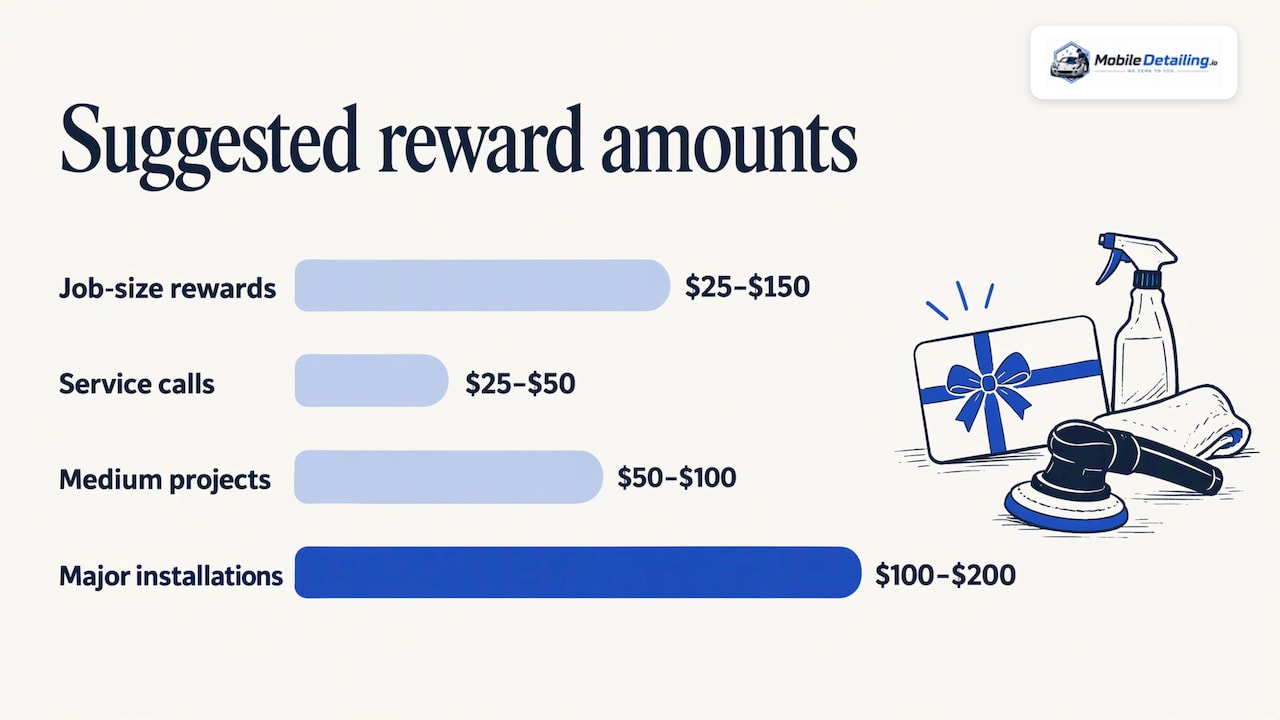
For reward size, published guidance from service-industry sources gives a rough scale. One home-service guide says the most effective rewards are cash or prepaid cards of $25 to $150 depending on job size. A contractor guide suggests $25 to $50 for service calls, $50 to $100 for medium projects and $100 to $200 for major installations. These are suggestions from software and marketing companies, not detailing-specific research, so treat them as a starting range and check them against your own margins.
One rule of thumb holds up: size the reward from what you earn on the new customer, not from what looks generous. One reward guide says to size the amount from gross margin on the introduced customer and leave headroom for churn. Another suggests checking that the math still works if only 20% of referrals convert.
Referral program ideas that suit mobile detailers
1. A double-sided credit
Both people get something. The existing customer earns a credit toward their next detail, and the friend gets a discount on a first booking. ReferralRock explains why this tends to outperform one-sided rewards: it changes the dynamic from a sales pitch to a gift. The customer is not asking a favor. They are handing a friend a deal.
A service-business example from Jobber’s guide pairs a free maintenance cleaning for the referrer with a $50 gift card for the new recurring customer. For a detailer, the same shape could be a free interior refresh for the referrer and a set dollar amount off for the friend’s first full detail. Pick amounts that fit your own pricing.
2. Service credit for maintenance clients
If you run recurring washes, a credit works better than cash. It costs you less than its face value, since it is your time and supplies. It also pulls the customer back onto your schedule. Tie it to the next booking only, with no cash value.
3. Cash or gift cards for coatings and paint work
When a job runs well above your average ticket, a credit is not much of a thank-you, because the customer may not book again for years. Cash, a prepaid card or a gift card to a local restaurant makes more sense. The contractor ranges above give you a place to begin. Pay when the job is complete.
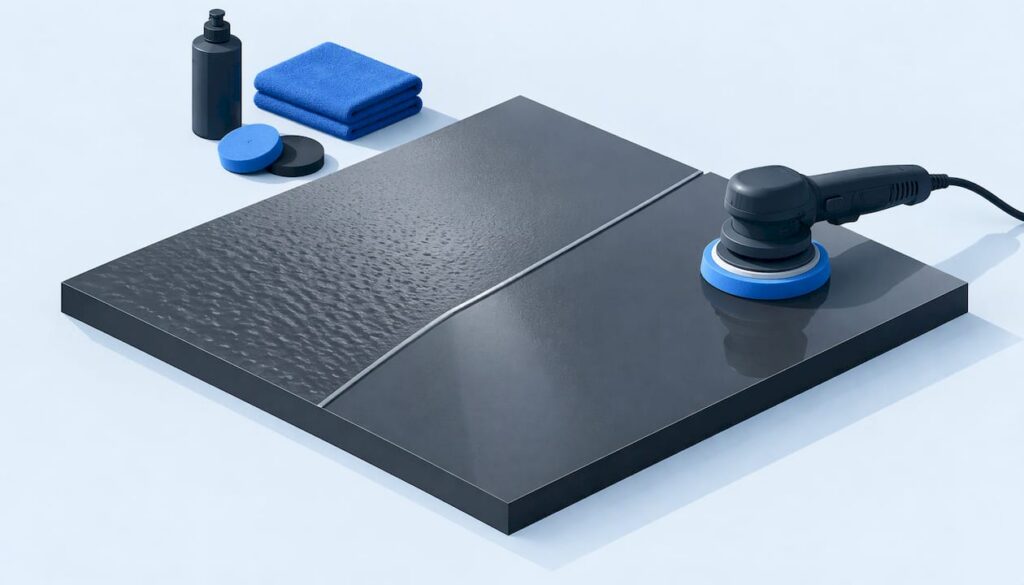
Ceramic coating, paint correction and wet sanding are skilled work where the result depends on the person doing it. Referral rewards should only ever point customers toward professionals who do this work. If you want a sense of who offers it near a customer, MobileDetailing.io lists ceramic coating specialists by location.
4. Free add-ons instead of discounts
A free upgrade protects your price and gives the customer a taste of a service they may buy later. Service guides suggest free upgrades or add-ons, such as a deep clean of one extra item. In detailing that could be a headlight restoration, an engine bay wipe, a fabric protectant on the seats, or a trunk and cargo-area clean added to the next visit. Choose add-ons that cost you little time and showcase your quality.
5. Tiered rewards for your best advocates
Some customers refer again and again: property managers, car-club members, boat marina regulars, rideshare drivers who know other drivers. A tier structure rewards them. ReferralRock describes a customer earning $25 per referral who moves to $50 per referral after five successful ones. A detailing version might be a larger credit or a free full detail after a set number of completed referrals.
6. Partner referrals
Businesses that touch vehicles before or after you are natural partners: dealerships, body shops, tint shops, boat storage yards, RV parks, marinas. Service-business guides list partnerships and partner-business discounts among their ideas. Offer each partner a small fee or credit per completed job, and give their customers a card with a code that identifies the source.
7. Fleet and commercial referrals
Fleet managers and dealership managers talk to each other. A single account can mean recurring work. Since the deal is bigger, scale the reward to the deal rather than paying a flat amount. One guide notes that most service businesses pay 1 to 5% of deal value, so a reward for a commercial contract will look different from a reward for a single-car detail.
8. A seasonal or limited-time push
Detailing has seasons: spring cleanup, pre-road-trip prep, post-winter salt removal in northern states, pre-summer boat commissioning. A time-boxed offer tied to one of these creates a reason to share now. Run it as a campaign on top of your standing program. Do not use it to replace one.
What to skip
Skip complex point systems, contests with many rules and rewards that need a paragraph to explain. One guide recommends keeping the offer understandable in under 15 seconds, with one reward per side and one action. Another advises picking one structure and running it for a few months before adding complexity.
How to ask so customers actually refer
The best moment is right after the customer sees the finished work. Referral advice for service businesses consistently says to make the ask right after a great experience rather than in a generic monthly email. Give them something to hand over, such as a code, a link or a printed card.
One template for a home-service business describes a four-step sequence: a physical card with the customer’s name and code at job completion, an email the next day with a shareable link, a text reminder about two weeks later, and a prompt to share on Facebook, Nextdoor or by text. For detailing, the same sequence works well. The card goes on the dash or in the door pocket, and the follow-up message goes out with the invoice or the before-and-after photos.
Places to promote the program, drawn from service-business guidance:
- Your website, with a short referral form or a page with the offer
- Invoices, receipts and business cards
- Vehicle wraps, door hangers and flyers
- Email signatures and follow-up messages
- Social media posts that show finished work, with the customer’s permission
If few people refer, do not rush to raise the reward. One reward guide argues that low participation is usually a visibility problem: customers forgot, or never saw the offer. Make the ask earlier and easier first.
Privacy matters here. If your referral form collects a friend’s name or phone number, get permission first. The same guidance says to include a reminder to get permission before sharing someone’s personal information.
How to build the program in six steps
- Set one goal. Booked jobs, quote requests or completed jobs. Completed jobs is the cleanest, because it ties the reward to real revenue.
- Write the offer in one sentence. For example: “Refer a friend, they save on their first detail, and you get a credit after it’s done.” Fill in your own amounts.
- Decide the trigger for payment. Count a referral only after the work is done and paid. One template advises counting a referral only after payment clears and the refund period ends.
- Build the share path. A unique code per customer is enough to start. A phone-friendly page or a QR code on your card makes sharing easier.
- Pilot with your happiest customers. Start with the ones who already leave good reviews or rebook. Their friends are the most likely to trust you.
- Review monthly and change one thing at a time. That makes it clear which change moved the numbers.
A tying-to-completion example comes from a daylighting company’s case study. It paid its $100 advocate reward only when the referred customer’s installation was done, so rewards reflected real jobs and not casual interest. That is the same logic as paying after a detail is finished.
Track it with a spreadsheet before you buy software
You do not need a platform on day one. One service-business template uses a seven-column tracking sheet: date, referrer, referred lead, status, job value, fee due and fee paid date. That fits detailing as is.
Two more habits keep the numbers honest:
- Ask every new customer how they found you, and record the referrer’s name or code.
- Block self-referrals by matching name, email or phone against existing customers.
For judging results, a few measures are enough: referrals per month, how many referred leads book compared with other sources, revenue from referred customers, and cost per referral. A home-service guide says to tie every referral to a name, phone number, code or link and to compare referral close rates against paid ads. Published benchmarks in this space come from software and marketing vendors, not independent studies, and they are for other trades. Use them as rough reference points, and build your own baseline over a few months.
MobileDetailing.io has a step-by-step guide to detailing referral programs if you want a detailing-specific walk-through.
Write short, fair terms
Terms protect you and keep the program clear. A service-business template suggests five points: credits apply to the next booking only with no cash value, the new-customer discount applies to the first booking only, fake accounts void credits, credits expire after 12 months, and the program can change with 30 days’ notice. It also suggests keeping the terms under 200 words, because long terms feel adversarial.
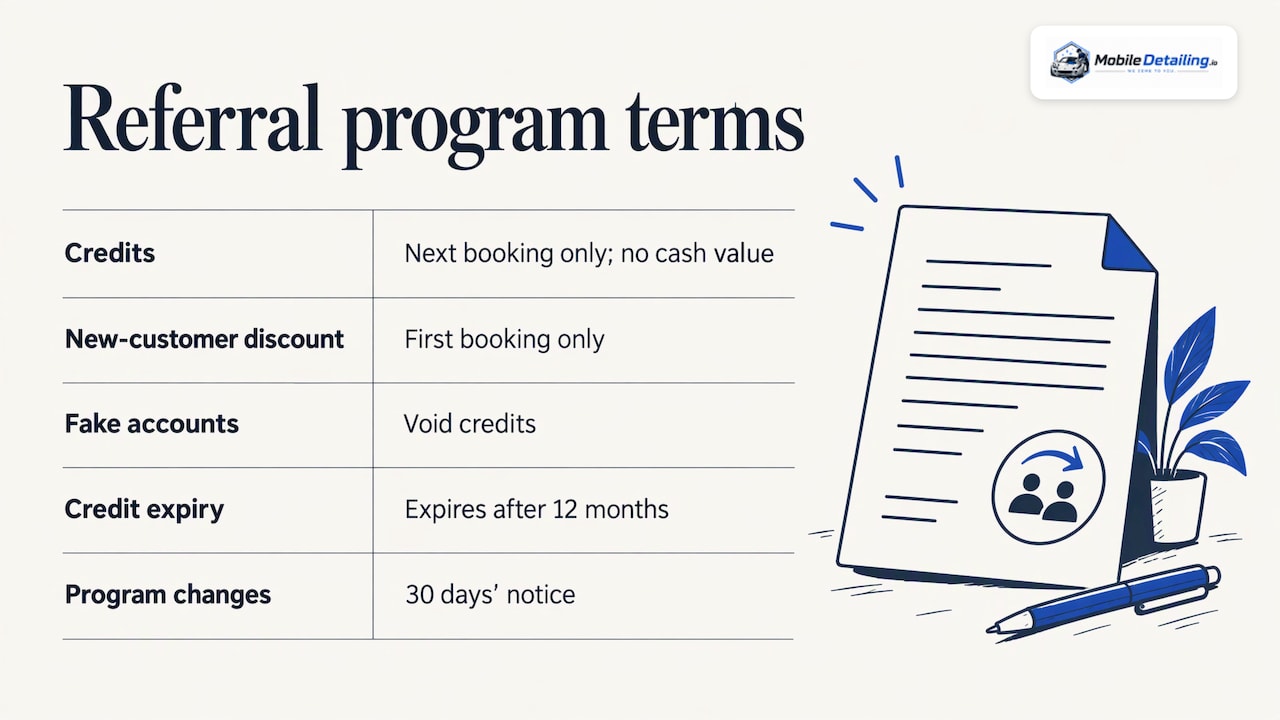
For those 12 months and that 30-day notice, treat the template as a starting draft, not a standard. If you pay out larger cash rewards, talk to your accountant. Under federal rules, businesses generally report payments to non-employees on Form 1099-NEC. The reporting threshold rises from $600 to $2,000 for payments made in tax year 2026, and some state rules differ. Credits and discounts on your own services avoid most of that paperwork, which is one more reason they suit routine detailing.
Referrals work best when people can find you
A referral is only as good as what happens when the friend searches your name. They will look for reviews, photos and the services you offer, and many will compare you with a couple of other local detailers before booking. That is where a complete profile helps.
MobileDetailing.io is a nationwide directory where detailers can add or claim a listing, show services, photos and reviews, and receive quote requests. Free and paid listings are available, and paid options add priority placement, analytics and extra profile features. Vehicle owners search by location and use it for free. A friend who got your card can find your profile and request a quote in the same visit. If you do not have a listing yet, start at MobileDetailing.io and claim yours.
See how other detailers present themselves, for example Elite Detailing in St. Louis, KC Detailing in Kansas City or Swift Marine Boat Detailing in Hialeah.
If you are a car, boat or RV owner
When a detailer offers you a referral credit, it is a thank-you for passing along a business you trust. Share the code with friends who have a similar vehicle and similar needs. Someone with a family minivan full of crumbs needs a different service than someone with a ceramic-coated sports car. If you want to find a detailer yourself, you can request a local quote for free.
For wet sanding, paint correction, coatings or hazardous chemical work, choose a professional. These jobs can damage paint or harm your health when done without training and the right equipment.
FAQ
What is a good referral reward for a detailing business?
It depends on the job. For maintenance details, a service credit or free add-on is usually enough. For coatings, correction or boat and aircraft work, cash or a gift card in the $25 to $150 range suggested for home services is a reasonable starting point. Test it against your margin on the new customer.
Should both the customer and the friend get a reward?
Yes, in most cases. Double-sided offers feel like a gift and not a favor. One guide recommends giving both sides the same value so the friend does not feel the referrer is benefiting unequally.
How do I track referrals without software?
Give each customer a code or a card, and ask every new customer who sent them. Record it in a spreadsheet with the date, referrer, new customer, job value and reward status. Pay the reward only after the job is complete.
How often should I ask for referrals?
Ask right after the job, when the customer sees the result, and send a short follow-up message within a day or two. A light reminder a couple of weeks later is reasonable. Do not send generic monthly blasts.
Sources
- What Is A Referral Program and Why Your Business Needs One
- Refer a Friend Program Guide: Examples + Rewards (2026)
- 22 Customer Referral Program Ideas That Actually Work
- 14 Customer Referral Program Ideas (With Examples)
- Referral Program Guide for Contractors
- Picking the Right Reward
- How to Start a Referral Program for Your Service Business
- Referral Program Template: Examples Plus Email & Text Copy
- 10 Customer Referral Program Ideas for Service Businesses
- How to Set Up a Referral Program for Your Service Business
- Referral Program Ideas for Service Businesses
- Carpet Cleaning Referral Program Template
- How a Natural Daylighting Business Generated $49,749
- Referral Program Templates: 6 Frameworks You Can Launch
- HVAC Referral Program
- Guide to Customer Referral Programs
- One Big Beautiful Bill Act changes 1099 thresholds
Recommended
MobileDetailing.io provides general educational information. Products, surfaces and vehicle finishes vary. Follow manufacturer instructions and consult a qualified detailing professional before using abrasive processes or chemical treatments.