Copyable One Page Mobile Detailing Business Plan and US Startup Costs
A full mobile detailing business plan needs four answers: who you serve, what you sell, what it costs to run and price a job, and how customers actually find you. A one-page plan covers this fine for launch; you only need a longer, multi-page version if you’re approaching a lender or bringing on a partner. Budget $5,000 to $15,000 to start if you already own a vehicle, with breakeven typically arriving within the first two to three months of steady bookings.
Table of Contents
- What Should Be in a Mobile Detailing Business Plan?
- What Does It Cost to Start a Mobile Detailing Business?
- How Do You Price Detailing Jobs and Project Revenue?
- What Marketing Should Be in Your Plan?
- What Licenses and Insurance Does a Mobile Detailer Need?
- A Sample One-Page Plan You Can Copy
- Testing Your Plan in the First 90 Days
- Sources
- FAQ
What Should Be in a Mobile Detailing Business Plan?
Each section of the plan has one job: force you to write down an assumption before you spend money testing it. Here’s what belongs in each part.
Executive summary. Two to three sentences stating who you serve, your core service area, and your first-year revenue target. Lead with the headline numbers: startup budget, target jobs per week, and average ticket price. This is the section a lender or a curious spouse reads first, so make it concrete rather than aspirational.
Mission, objectives, and KPIs. Skip the mission-statement fluff and write measurable targets instead: jobs per week, average ticket size, and repeat customer rate. A solo operator running several jobs per week at a moderate average ticket has a very different plan than one chasing fleet contracts at scale.
Business structure. Sole proprietorship is the fastest way to start and costs nothing extra, but it leaves personal assets exposed if a customer sues over vehicle damage. An LLC costs more upfront with state filing fees that vary by state and requires an EIN and a separate business bank account, but it separates your personal finances from the business. Most solo detailers start as sole proprietors and convert to an LLC once revenue is consistent.
Operations. Define your service area radius, working hours, and whether you’re solo or hiring help. Write basic standard operating procedures for arrival, protection of the customer’s property, and job completion, even if it’s just a checklist taped inside your van.
Before moving to the next section, confirm you’ve written:
- A one-sentence description of your ideal customer
- Your three core service packages and their price points
- Your break-even number of jobs per week
- Your primary customer acquisition channel
What Does It Cost to Start a Mobile Detailing Business?
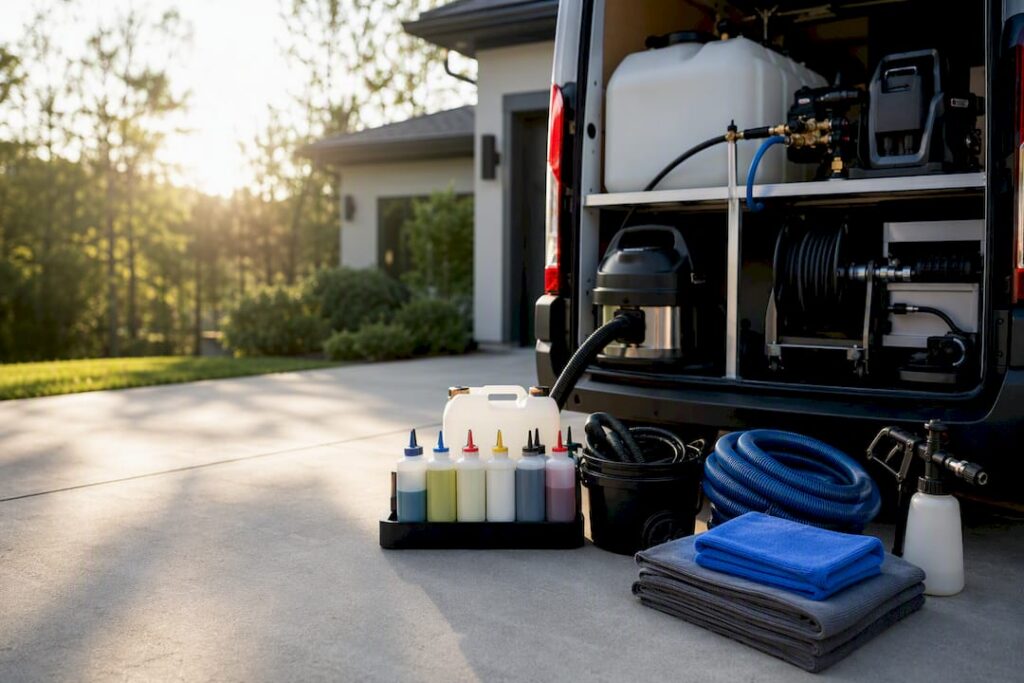
Startup costs split into two tracks: lean and full. A lean launch, using a vehicle you already own and buying only essential gear, runs $5,000 to $15,000. A full setup with a dedicated van, built-out water system, and premium equipment can push past $30,000.
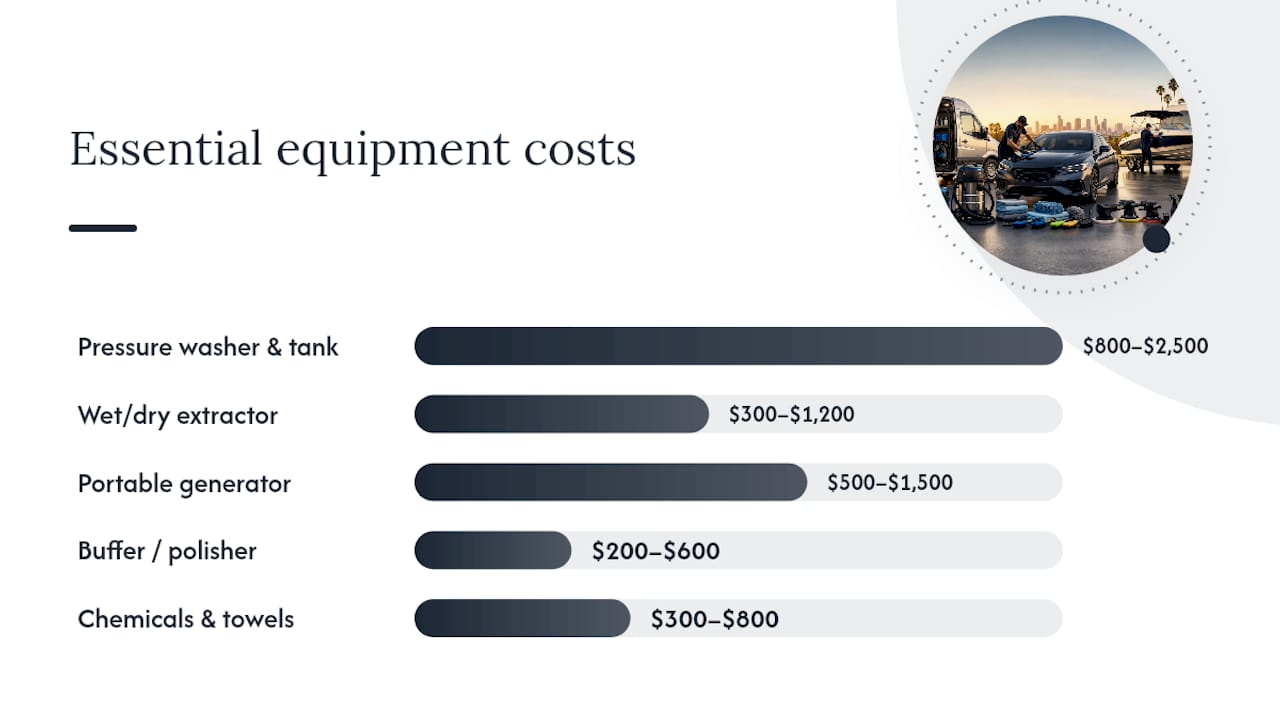
Essential equipment and rough U.S. price bands:
- Pressure washer and water tank system: $800 to $2,500
- Wet/dry extractor for interiors: $300 to $1,200
- Portable generator: $500 to $1,500
- Buffer/polisher and pad kits: $200 to $600
- Chemicals, microfiber towels, and applicators: $300 to $800 initial stock
- Business insurance (first-year premium): $600 to $1,500
Pro Tip: Buy your generator and extractor used from a detailer upgrading their setup. These tools hold up well secondhand and can cut $500 or more off your initial cash outlay.
Your vehicle is the biggest variable. Using a car you already own with a trailer setup keeps costs lowest. A used cargo van with a built-in water tank costs more upfront but looks more professional to commercial clients like dealerships and fleet accounts. Fieldtics notes that many solo operators launch successfully with a used van and basic equipment rather than waiting to afford a fully custom rig. Phasing your purchases, buying used where you can, and negotiating net-30 terms with chemical suppliers all reduce the cash you need on day one.
How Do You Price Detailing Jobs and Project Revenue?
Cost-per-job math is the backbone of your pricing, and skipping it is how new detailers end up working for less than minimum wage. Calculate it with these components:
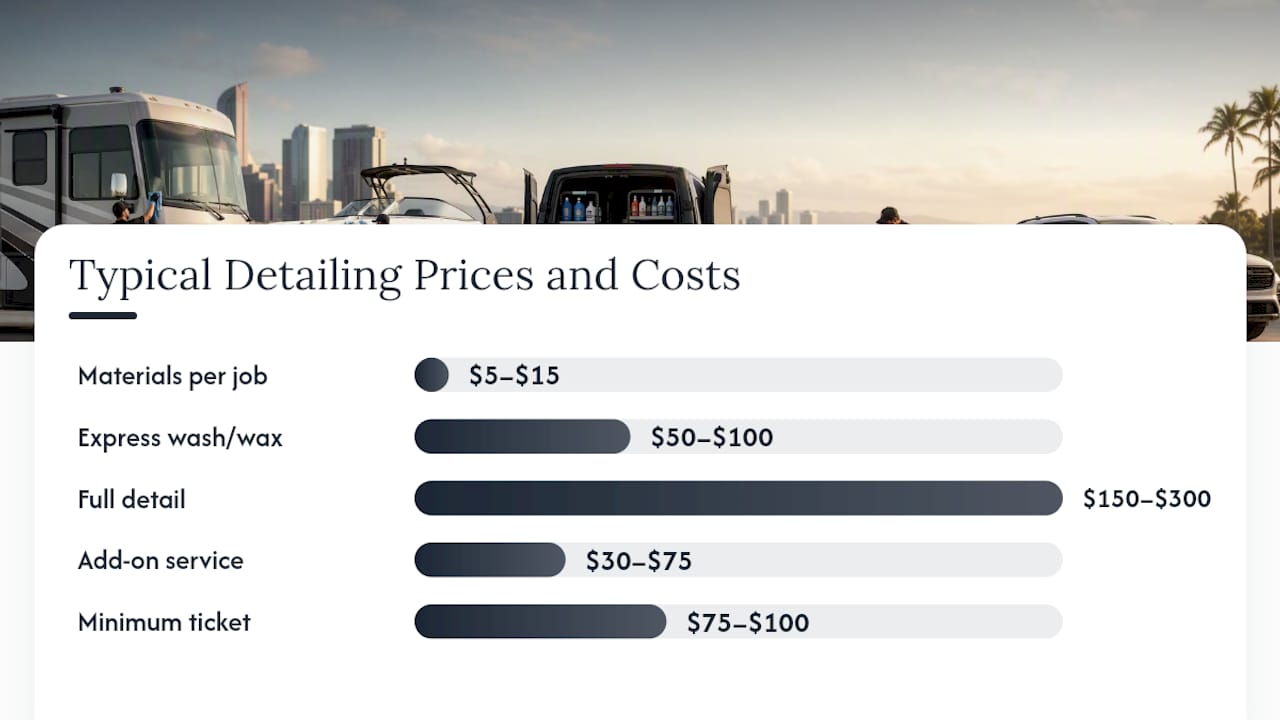
- Materials cost per job: chemicals, towels, and consumables, typically $5 to $15 per standard detail
- Labor time: your hourly rate multiplied by hours on-site, not including drive time
- Drive time cost: fuel plus the opportunity cost of time spent traveling instead of detailing
- Platform or card processing fees: usually 2.5% to 3% if you accept card payments
Package pricing typically breaks down as an express wash/wax around $50 to $100, a full interior/exterior detail around $150 to $300, and add-ons like paint sealant or pet-hair removal priced as upsells at $30 to $75 each. Mobile services often justify a premium over fixed-location shops because customers pay for convenience, and survey data on the detailing category shows mobile operators command pricing that reflects this.
Set a minimum ticket, often $75 to $100, below which you decline a job. Driving 25 minutes for a $40 wash loses money once fuel and time are counted. Build your daily route around geographic clusters instead of accepting jobs scattered across town.
For your 30/60/90 day projection worksheet, track: jobs booked, average ticket, total revenue, materials spend, fuel cost, and net cash after expenses each month.
What Marketing Should Be in Your Plan?
Your plan should name specific channels and what you expect from each, not just “social media and word of mouth.”
- Claim and fully complete your Google Business Profile with photos, service categories, and your service area; this is often the single highest-return item for local search visibility.
- Set up automated review requests after every job, since ratings and review counts strongly influence which detailer a customer calls first.
- Pitch fleet accounts, used-car dealerships, marinas, and property management companies directly. These relationships produce recurring, high-volume work instead of one-off bookings.
- Use before-and-after photo and video content on social platforms, and adopt booking and payment software that sends automated appointment reminders to cut no-shows.
Pro Tip: Respond to every review, good or bad, within 24 hours. A thoughtful reply to a three-star review often does more for your reputation than five unanswered five-star ones.
What Licenses and Insurance Does a Mobile Detailer Need?
Requirements vary by city, county, and state, so treat this as a checklist to verify locally rather than a fixed list.
- A general business license, usually issued at the city or county level
- A sales tax permit if your state taxes detailing services
- General liability insurance to cover accidental vehicle or property damage
- Garagekeepers insurance if a customer’s vehicle is in your care, custody, or control
- Commercial auto insurance for your work vehicle, since personal auto policies typically exclude business use
- Workers’ compensation coverage once you hire your first employee
Wash-water runoff is the most commonly overlooked compliance item. Many municipalities restrict letting soapy wastewater flow into storm drains, so containment mats, portable reclaim systems, or working only at properties with drain access matter. Fieldtics outlines containment options that satisfy most local rules. Call your city’s public works department directly to confirm what applies to your specific operating area before you take your first booking.
A Sample One-Page Plan You Can Copy
A one-page plan fits on a single sheet with four blocks: who you serve (commuters, luxury car owners, fleet managers), what you sell (three packages with prices), your cost structure (startup budget, cost-per-job, break-even job count), and your marketing plan (Google Business Profile, three target partnerships, review process).
- Expand to a full multi-page plan only when you’re applying for a loan, taking on a partner, or pursuing a franchise agreement.
- Convert your one-page cost block into a spreadsheet once you’re ready to track actual monthly numbers against projections.
- MobileTechRx offers a downloadable template with formatted sections if you want a starting document rather than a blank page.
| Plan section | What it should state |
|---|---|
| Who you serve | Target customer type and service radius |
| What you sell | Package names and price points |
| Costs | Startup budget and cost-per-job |
| Marketing | Primary channels and review process |
Testing Your Plan in the First 90 Days
- Scan your local market for pricing and competitor density before setting your own rates
- Run five to ten practice jobs, even discounted ones, to time your workflow accurately
- Test your pricing against customer responses and adjust accordingly before finalizing packages.
- Set up online booking and payment collection before your first paid customer, not after
A tight 90-day operational checklist like this catches bad assumptions fast, before they compound into a cash problem three months in. The most common early mistakes: underpricing out of fear of losing the job, forgetting to price in drive time, skipping insurance to save cash, and running bookings through text messages instead of a real scheduling system.
Pro Tip: Track every job’s actual time versus your estimate for the first month. Most new detailers underestimate job time by 20 to 30 minutes, and that gap is where profit quietly disappears.
Sources
Pricing benchmarks come from the 2026 Carwash Magazine detailing survey and IBISWorld’s industry report. For a plan template, see MobileTechRx’s guide, and generate customer leads once you launch through Mobiledetailing.
- Detailing Survey — Carwash Magazine (January 2026)
- How to Start a Mobile Detailing Business — Fieldtics blog
- Should I open a mobile detailing business in 2027? — PulseRevOps
FAQ
Is a Mobile Detailing Business Profitable?
Yes, for most solo operators who price correctly and manage drive time. Realistic Year-1 personal cash flow for an owner-operator under favorable conditions falls in the $75,000 to $110,000 range, though results vary by market and hours worked.
How Much Money Do I Need to Start a Mobile Detailing Business?
Most solo operators launch on $5,000 to $15,000 if they already own a suitable vehicle. A full setup with a dedicated van and premium equipment can run $30,000 or more.
Is Mobile Detailing Oversaturated?
Demand is growing, but so is competition from franchise models and detailers converting to fixed shop locations, according to 2026 industry commentary. Specializing in a niche, like fleet accounts or ceramic coatings, and building strong online visibility helps you stand out in crowded local markets.
What License Do I Need for a Mobile Detailing Business?
Requirements vary by city and state, but most mobile detailers need a general business license, a sales tax permit if applicable, and proof of general liability and commercial auto insurance. Always confirm exact requirements with your local city or county clerk’s office before starting.
MobileDetailing.io provides general educational information. Products, surfaces and vehicle finishes vary. Follow manufacturer instructions and consult a qualified detailing professional before using abrasive processes or chemical treatments.