Service Area Strategy for Detailers: Pick Areas by Profit, Not Leads
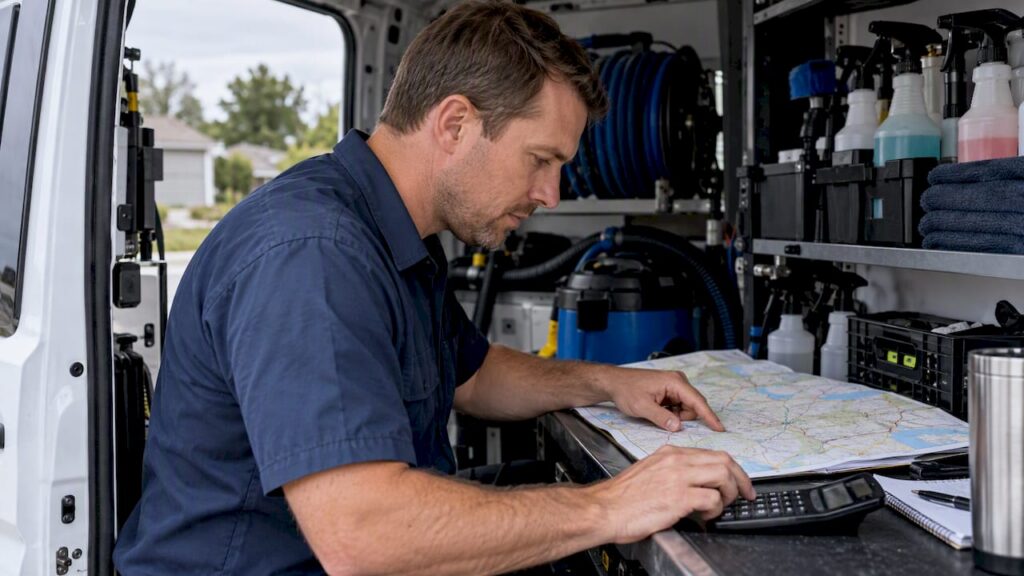
A service area strategy means defining a precise, realistic set of places you serve, then prioritizing a handful of them based on demand and profitability instead of trying to cover an entire region. The next step is to make those choices visible everywhere customers and search engines look: one optimized Google Business Profile and a set of targeted service-area pages that match what you actually offer.
Table of Contents
- How to choose which locations to target
- Service-area pages: structure and formatting that performs
- Google Business Profile: settings and rules for service-area businesses
- Structured data and technical signals that help local visibility
- Reviews and multi-platform visibility: beyond Google
- Measure and iterate: KPIs, A/B tests, and when to change your service-area targets
- How MobileDetailing.io supports a service-area strategy
- Integration of service area strategy with mobile detailing scheduling and routing for operational efficiency
- Tailoring service area strategy for different vehicle types offered
- Another option: use MobileDetailing.io to capture local quote requests and increase visibility
- FAQ
- Sources
How to choose which locations to target
Before building any page or adjusting a Google Business Profile, figure out where the work already is. Pull booking logs and past invoices to see which cities or zip codes already generate jobs, repeat customers, and higher ticket sizes. This existing data is more reliable than guessing based on population size or drive time alone.
From there, apply a practical filter:
- Inventory current demand. Sort past jobs by location and revenue to spot clusters worth defending or expanding.
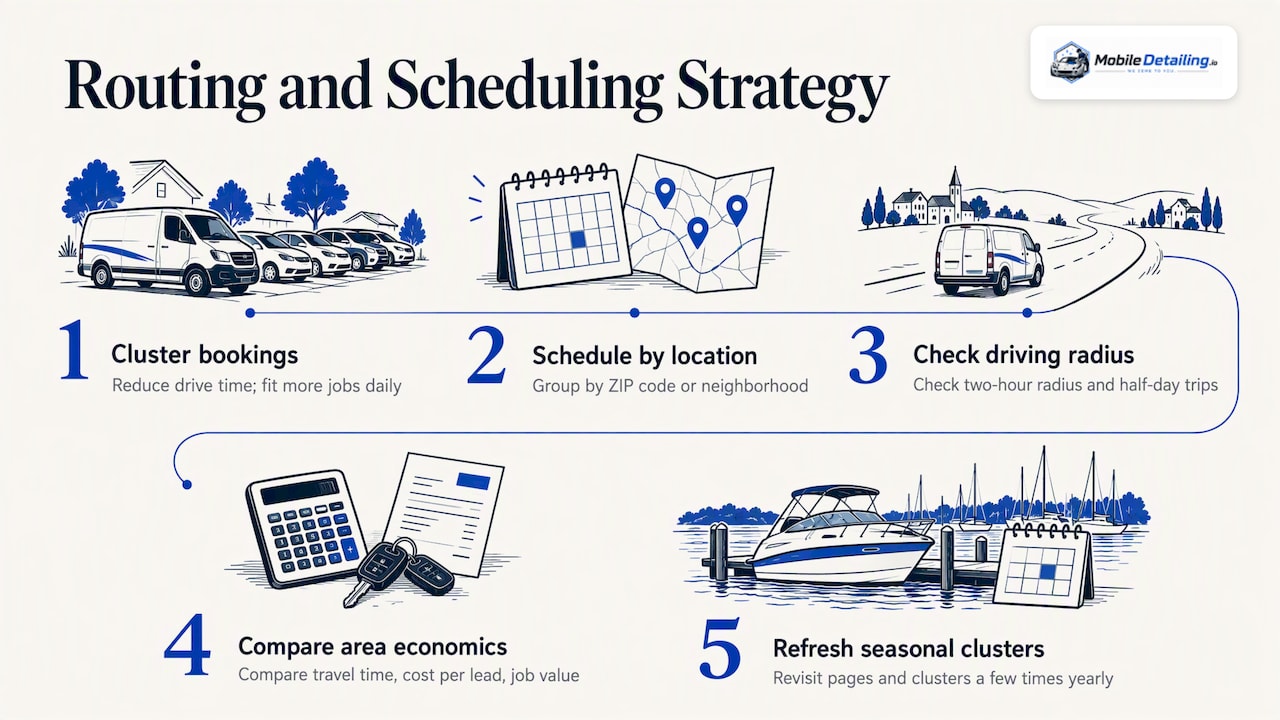
- Apply a driving-time limit. Google recommends keeping service areas within about two hours of your business base, which also keeps fuel and labor costs in check.
- Score each candidate location. Weigh search demand, how many competitors already rank there, average order value, and travel overhead for each place on your shortlist.
- Pilot before scaling. Run a small, localized campaign, a minor Google Business Profile adjustment, and a single landing page in one new area before committing to a dozen.
This sequence keeps the strategy grounded in numbers you already have rather than assumptions about where customers might be.
Pro Tip: Rank candidate cities by profit per job, not just lead volume; a smaller town with less competition often beats a crowded metro on margin.
Service-area pages: structure and formatting that performs
A service-area page works when it reads like it was written for one specific place, not copied and lightly edited for fifty. Each page should pair one place, whether a city or a zip code cluster, with one primary service, and it needs content that would be genuinely useful even without the local keyword attached.
What separates a page that ranks from one that doesn’t:
- A clear statement of the service boundary, such as neighborhoods or surrounding towns actually covered.
- References to local landmarks, neighborhoods, or job types common in that area.
- Photos and short examples from completed jobs in or near that location.
- A URL and heading pattern that stays consistent across pages, such as “/exterior-detailing-in-[city]” with an H1 that names the service and place together.
- A decision point for when several small, low-demand towns should be folded into one regional page instead of each getting a thin, separate page.
Google’s spam policies flag mass-produced location pages with little unique value as doorway abuse, so pages built only to swap city names in and out of a template put rankings at risk. Consolidating nearby low-demand places into a single regional page, then investing real detail into your top three or four priority cities, tends to outperform spreading thin content across twenty pages.
Pro Tip: Write the local proof section first. If you can’t fill it with a real detail about that place, the page probably isn’t ready to publish.
Google Business Profile: settings and rules for service-area businesses
A mobile detailing business almost always fits the service-area profile type rather than a storefront, since the work happens at the customer’s location rather than a shop address. Google’s guidelines are specific about how this should be set up and what to avoid.
- Create only one Business Profile per metropolitan area you serve; Google’s guidelines warn against multiple profiles for the same business in one metro and against virtual offices that sit unstaffed.
- Hide your street address for a pure service-area business and set your coverage by city or postal code, up to 20 areas per profile.
- Choose the most accurate primary and secondary categories, list each service you actually perform, and upload recent, real photos of your work.
- Keep your business name, phone number, and hours identical across your website, listings, and social profiles.
- Check performance regularly: verify the profile, confirm the address visibility setting matches your business type, and review the services and areas listed at least quarterly.
Our guide to claiming and optimizing a business listing walks through the verification steps in more detail for detailers setting up a profile for the first time.
Structured data and technical signals that help local visibility
LocalBusiness structured data, written as JSON-LD, helps Google understand what a page is about, but it only works when it matches what a visitor actually sees on the page. Google Search Central’s structured data guidance is clear that markup must reflect visible content and should never be added to represent a location or service that isn’t genuinely offered there.
Properties worth including on a service-area page:
telephoneandurl, matched exactly to what’s displayed on the page.serviceArea, listing the specific cities or regions that page actually covers.openingHours, kept current if the business has set hours for calls or bookings.aggregateRating, only when real reviews are visibly displayed on that page.
One practical signal to watch: structured data that validates cleanly in Google’s Rich Results Test is a prerequisite for enhanced display, not a guarantee of it; Google’s own guidance notes that required properties must be accurate and present for a page to even be eligible.
Never add LocalBusiness markup to a thin or empty page just to signal local presence; it misrepresents the page to Search and can work against the rest of the site. Validate each template with the Rich Results Test, then watch Search Console for indexing and click data on those pages over the following weeks.
Reviews and multi-platform visibility: beyond Google
Google reviews still carry the most visible weight in local search, but customers increasingly research businesses across several channels before booking. BrightLocal’s research on consumer behavior shows that social platforms and video have become meaningful discovery and evaluation channels, alongside traditional review sites, which means a detailing business’s online reputation now lives in more than one place.
Practical moves that build on this:
- Ask for reviews shortly after a completed job, while the work is fresh, rather than relying on customers to remember later.
- Display recent, photo-rich reviews prominently on service-area pages rather than burying them in a separate testimonials page.
- Respond to reviews, especially negative ones, within about a week to show active management.
- Use Instagram or YouTube to post before-and-after clips from specific service areas, which can support the “justifications” Google sometimes shows in map pack results.
- Track review velocity and sentiment by area separately, since a city with slowing review growth may need renewed local marketing before it needs to be dropped.
Pro Tip: Tag each review request internally by job location so review trends by area become visible without extra reporting work.
Measure and iterate: KPIs, A/B tests, and when to change your service-area targets
A service area strategy only holds up if it’s measured against real numbers, not gut feel about which cities feel promising. The core metrics worth tracking by area are leads generated, conversion rate from lead to booked job, cost per lead, average job value, and the travel or time cost of serving that location.
- Set a baseline for your current top three to five areas using the last two to three months of booking data.
- Launch a pilot in a new target area: a localized ad, a dedicated city page, a small Google Business Profile adjustment, and UTM-tagged links to trace where leads originate.
- Compare results against the baseline after a defined test window, rather than judging performance after only a few days.
- Decide: scale areas that beat your cost-per-lead and job-value targets, consolidate or drop areas that lag, and adjust for seasonal swings in demand before making a permanent call.
| Metric | What it tells you |
|---|---|
| Leads by area | Where demand is actually coming from |
| Conversion rate | How well leads turn into booked jobs |
| Cost per lead | Efficiency of the marketing spend in that area |
| Average job value | Whether the area is worth the travel time |
Google Business Profile performance data, Search Console query data, and CRM booking tags together give a fuller picture than any single source, since each one captures a different stage of the customer’s path from search to booked job.
How MobileDetailing.io supports a service-area strategy
A nationwide directory listing extends reach into target areas without replacing the work of building service-area pages and an optimized Google Business Profile. It gives local searchers another place to find a detailing business and submit a quote request directly.
On a listing, a detailing business controls:
- The services displayed, matched to what’s actually offered in that area.
- Photos that show real completed work.
- Reviews and ratings visible to searchers browsing by location.
- Service-area keywords that align with the city pages already built.
Examples like Showcase Mobile Detailing Solutions in Mesa, AZ and Maximum Mobile Car Detailing in Richmond, VA show how a claimed listing pairs services and local proof with a specific place, similar to a well-built service-area page.
Integration of service area strategy with mobile detailing scheduling and routing for operational efficiency
Choosing target areas isn’t just a marketing decision; it shapes how efficiently jobs get scheduled and routed. A service area that looks attractive on paper can erode margin quickly if it adds significant drive time between appointments.
Grouping bookings by geographic cluster within a target area reduces windshield time and lets a detailer fit more jobs into a working day. Scheduling software that groups appointments by zip code or neighborhood, rather than booking strictly in the order requests arrive, keeps routes tighter and reduces fuel and wear costs.
This is also where the two-hour driving-time guidance becomes operational rather than theoretical. A city at the outer edge of that radius might generate decent lead volume, but if it can only be served with a half-day round trip, the true cost per job climbs well above what the lead numbers suggest. Reviewing travel time alongside the KPIs from the measurement section, specifically cost per lead and average job value, helps separate areas that are profitable from ones that only look profitable before accounting for drive time.
Seasonal demand shifts also affect routing. A boat detailing business, for example, may see target areas shift toward marinas and lake towns in the warmer months, which calls for revisiting both the service-area pages and the scheduling clusters a few times a year rather than setting them once and leaving them unchanged.
Tailoring service area strategy for different vehicle types offered
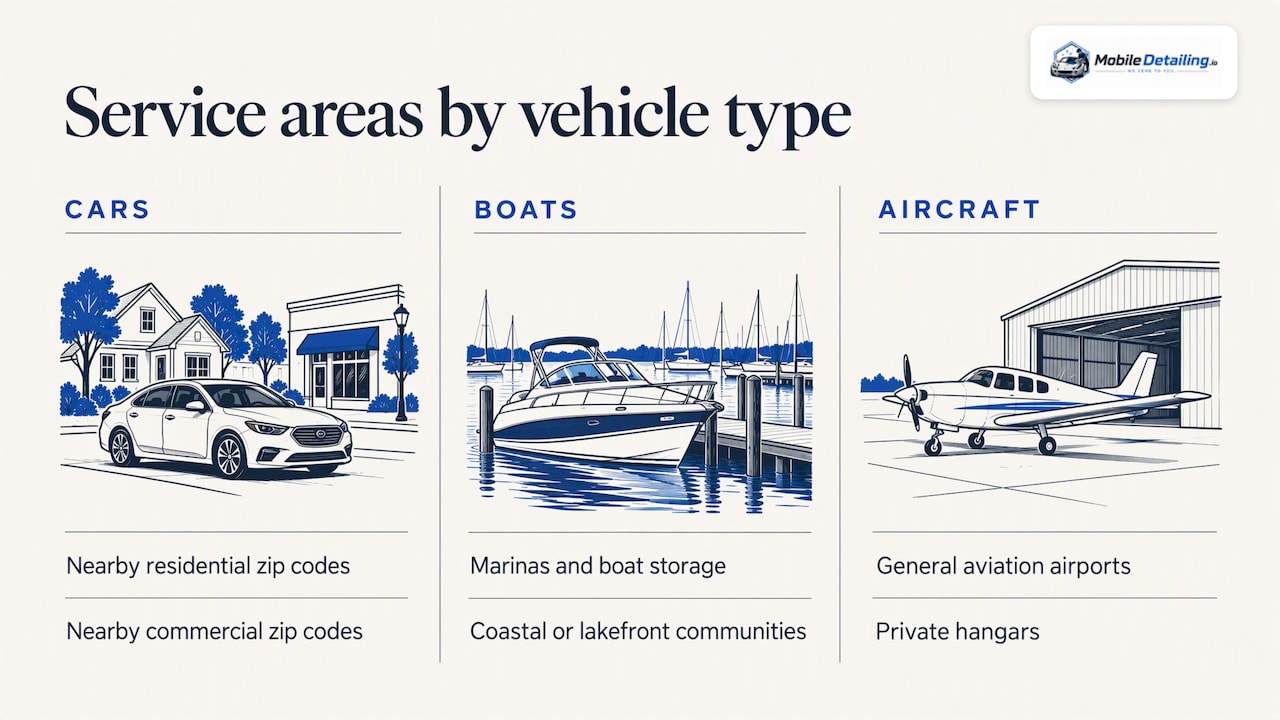
A service area that makes sense for standard car detailing doesn’t automatically make sense for boats or aircraft, since the customer base, travel logistics, and page content all shift with the vehicle type.
For cars, the strategy usually centers on dense residential and commercial zip codes close to the business base, since volume and repeat bookings drive profitability. For marine detailing, target areas shift toward marinas, boat storage facilities, and coastal or lakefront communities, often with a wider acceptable driving radius since jobs are fewer but higher in value. Pages for marine services should reference specific marinas or waterways rather than generic city names, since that’s how boat owners search.
Aircraft and helicopter detailing follow a different pattern again: target areas cluster around general aviation airports and private hangars rather than residential zip codes, and the addressable customer base in any one area is small, so pages and Google Business Profile service areas should be built around named airports or regions rather than broad city coverage. A single detailing business offering multiple vehicle types may need separate service-area pages, and in some cases separate profiles for distinct lines of business, to keep each one relevant to the searcher who lands on it.
Another option: use MobileDetailing.io to capture local quote requests and increase visibility
A service-area page and an optimized Google Business Profile cover search, but not every customer starts there. Listing a detailing business on a nationwide directory adds another path for local searchers to find available detailers and submit a quote request directly, which complements the organic work already done on city pages.
A claimed listing, such as Craft Detailing in Boston, MA or Pro Finish Detailing in Milwaukee, WI, lets a business show its services, photos, and service areas in one place that’s searchable independent of its own website. Claiming or updating a Mobiledetailing and linking it to the relevant city pages and Google Business Profile gives local customers one more reliable way to find and book a detailer, and gives detailers visibility into quote requests as they come in.
FAQ
Can you give me an example of a focus strategy?
A focus strategy in a service-area context means picking a small number of high-value places, maybe three to six cities or zip code clusters, and concentrating marketing, content, and review efforts there instead of spreading thin across a whole region. For a mobile detailer, that could mean building out detailed, unique pages for two or three priority cities rather than a shallow page for every town within driving range.
How to build a service-based business?
Building a service-based business generally starts with defining the specific services offered, identifying a realistic service area based on travel logistics, and setting up accurate online listings including a Google Business Profile. From there, consistent service quality, review collection, and locally relevant marketing content help establish visibility in the chosen area.
What are the 7 steps of customer service?
There’s no single universally agreed list of exactly seven customer service steps; frameworks vary by industry and source. A common version includes greeting the customer, listening to their need, confirming details, delivering the service, checking satisfaction, following up, and resolving any issues that arise.
What are 5 examples of a service?
Common examples of a service business include cleaning or detailing services, landscaping, home repair and maintenance, consulting, and personal care such as salon or spa treatments. Mobile detailing fits this category since it delivers a service at the customer’s location rather than selling a physical product.
Sources
- Sign up for Business Profile – Google Business Profile Help
- Consumer reviews: historical trends – BrightLocal
Recommended
- Book More Jobs This Week: Detailing Lead Generation for Detailers
- Detailers: Avoid Unlimited Liability in Dealership Detailing Contracts
- Compare: Price Detailing Services for U.S. Owners & Fleets ($150–$300)
MobileDetailing.io provides general educational information. Products, surfaces and vehicle finishes vary. Follow manufacturer instructions and consult a qualified detailing professional before using abrasive processes or chemical treatments.