Matte Paint Ceramic Coating: What Works and What to Avoid
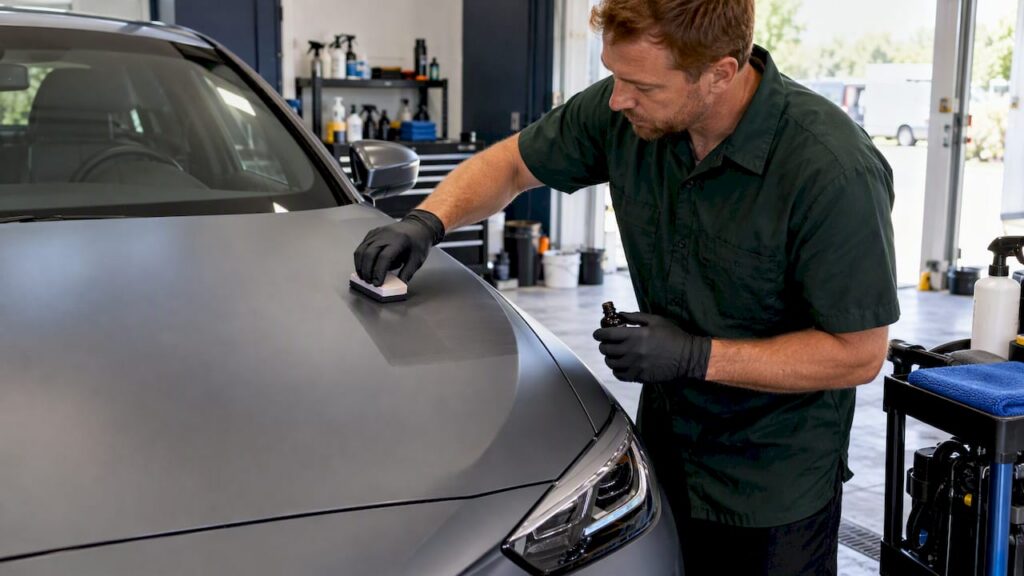
Yes, you can ceramic coat matte paint, but only with a coating made for matte and satin finishes, and only after careful prep. A gloss-oriented product can leave a permanent uneven sheen. A matte-specific coating is designed to protect the paint while keeping the flat, low-gloss look you paid for. This guide explains how those coatings work, what they can and can’t do, how prep and aftercare differ from gloss paint, and how to pick a professional to do the job.
Table of Contents
- Why matte paint needs a different approach
- What a matte ceramic coating actually does
- Factory matte, satin, matte wrap: does the surface matter?
- How a professional preps matte paint
- Cleaning a coated matte finish
- What to avoid: the mistakes that cost owners the finish
- Is a matte ceramic coating worth it?
- Choosing a mobile detailer for matte paint
- What if you need to remove or redo a coating?
- FAQ
- Sources
Why matte paint needs a different approach
Gloss paint is smooth and reflective. Matte paint is built to scatter light. Its clear coat has a microscopic texture, and that texture is what makes it look flat. The PPG matte finish care guide describes low-gloss paint as a distinctive finish that needs special care to keep its look.
That is the root of nearly every matte rule you will hear. Anything that fills, smooths or polishes the texture changes how light bounces off it. Waxes, polishes, glazes and many “shine” sprays do exactly that. PPG’s guidance says to avoid wax, polish and detail sprays made for glossy paint, and to avoid even mildly abrasive products such as rubbing compounds.
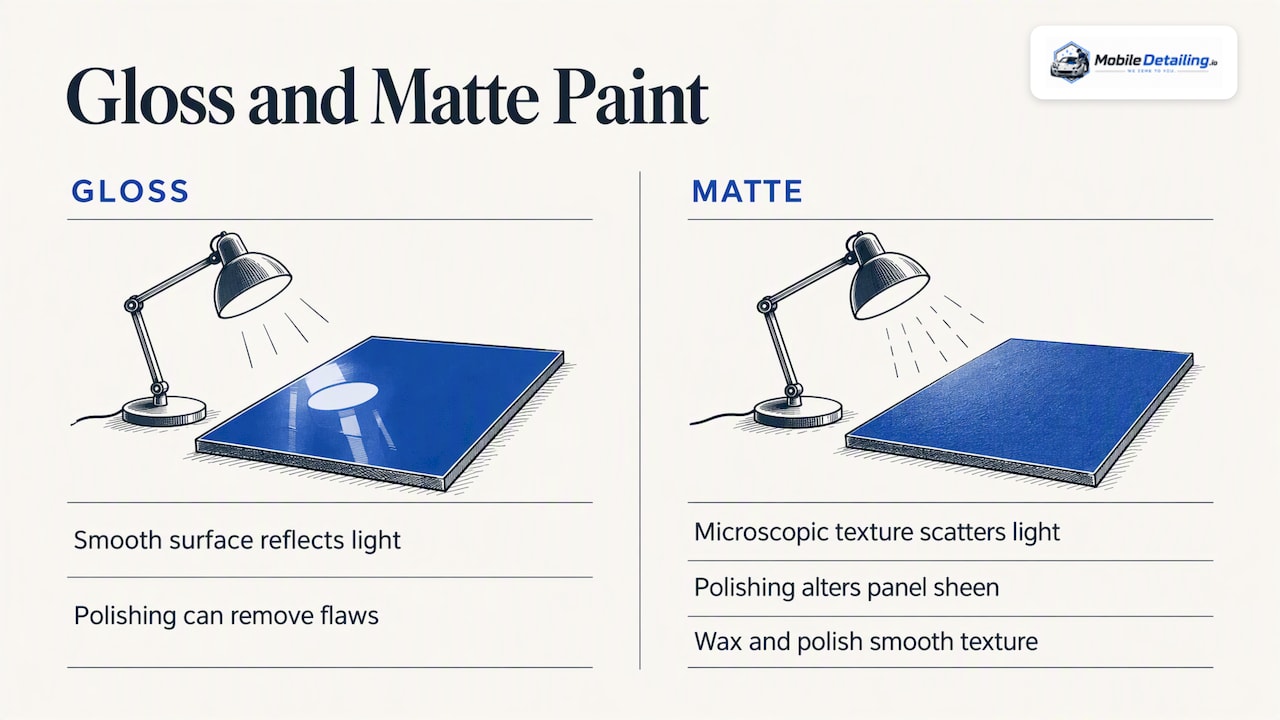
On gloss paint, a flaw can often be polished out. On matte, it usually can’t. You can’t buff a scratch or a blotchy patch away without changing the sheen of the whole panel. So the goal with matte is prevention: keep contamination off the surface, and keep your own cleaning gentle.
What a matte ceramic coating actually does
A ceramic coating is a liquid polymer that bonds to the paint. Car and Driver’s coating test notes that the term is partly marketing buzz, but there is real chemistry behind it. A matte version is formulated so that the cured layer doesn’t add gloss.
One manufacturer’s matte coating product page says its product is meant for matte and satin paint, PPF and vinyl, and that it protects without altering the original appearance. The same page claims hydrophobic, oleophobic and UV protection, and resistance to staining from things like bird droppings and tree sap. Those are manufacturer claims, not independent test results. Treat them as a description of intent.
What you can reasonably expect
- Easier cleaning. Water and dirt tend to release more readily from a coated surface, which means less contact and less scrubbing.
- A barrier against contaminants. Bird droppings, bug remains and sap are less likely to etch or stain quickly, though you still need to remove them promptly.
- UV resistance. Manufacturers claim it, so ask any installer what the specific product’s data sheet says.
- An unchanged look. A well-matched matte coating should leave the finish flat.
What you should not expect
- Protection from rock chips. Car and Driver’s testers stress that coatings are not a substitute for paint protection film when it comes to physical damage such as rock chips. If chips are your main worry, ask a professional about matte-finish PPF, a different product with a different job.
- A wash-free car. Coated matte paint still needs regular, gentle hand washing.
- A guaranteed lifespan. The manufacturer page cited above gives a range of roughly one to five years depending on maintenance. Real life varies with climate, parking, washing habits and how well the car was prepped. Our breakdown of ceramic coating lifespan claims covers why published numbers differ so much.
A useful way to think about it: a matte coating is about preserving the finish, not transforming it. It won’t make the paint look better than it did on day one. It aims to keep it looking that way longer.
Factory matte, satin, matte wrap: does the surface matter?
The label “matte” covers several different surfaces, and each one behaves differently.
| Surface | What it is | Key consideration |
|---|---|---|
| Factory matte paint | Matte clear coat applied at the factory | Texture is in the clear coat itself, so it can’t be polished or corrected |
| Satin paint | Low-gloss, slightly more sheen than matte | Same rules as matte: no polishing, no wax |
| Matte repaint | Aftermarket matte clear coat | Confirm the paint has fully cured before any coating goes on |
| Matte vinyl wrap | Vinyl film over the original paint | Check that the coating is rated for vinyl, and ask about wrap-specific cure and wash timing |
| Matte PPF | Clear or matte urethane film | Some coatings are made specifically for PPF; confirm with the installer |
A coating’s technical data sheet will say which surfaces it is approved for. One matte, wrap and PPF coating technical data sheet lists a thickness of about one micron, a contact angle of 93 degrees and a 9H hardness rating that depends on the surface. Those are the manufacturer’s own figures. Hardness ratings like 9H are a marketing convention more than a scratch-proofing promise, so don’t read them as armor.
If your car has a wrap, ask the installer who applied it before coating. Cure times for adhesive and film can affect when a coating is safe to apply.
How a professional preps matte paint
Prep is where matte coating jobs are won or lost. A research review in the journal PMC on car coating materials says surface preparation is critical for adhesion and long service life. Typical steps include a full wash, clay-bar decontamination, degreasing and, on gloss paint, paint correction by polishing.
That last step is the problem on matte. You can’t polish matte paint. So the prep for a matte car usually leans on gentle chemical decontamination and careful cleaning rather than abrasion. Here is the general sequence a careful installer is likely to follow, though the exact steps depend on the product and the paint:
- Inspect the paint. Look for existing glossy patches, scratches, swirl marks, stains or failed repaint areas under good light. Flaws can’t be corrected afterward, and a coating will lock them in.
- Hand wash with matte-safe soap. No mechanical brushes, no automatic wash, no terrycloth towels.
- Decontaminate without abrasion. Matte surfaces generally can’t take aggressive claying, so a professional chooses methods and products appropriate for the specific paint. Ask what they use and why.
- Remove oils and residue. A wipe-down with a product that leaves no film helps the coating bond. The installer should follow the coating maker’s instructions.
- Apply in a controlled space. Even, well-lit application is crucial, since uneven leveling shows up as patchiness that can’t be buffed out.
- Cure. The car needs to stay dry and away from washing for the period the manufacturer specifies.
A general-purpose gloss-paint routine, such as claying, polishing and then coating, is the wrong template for matte. If a detailer proposes polishing your factory matte paint, that is a red flag.
Why this is not a weekend DIY job for most people
DIY matte kits exist, and plenty of owners do apply them. But matte is unforgiving: a missed spot, a high spot or a stray gloss-enhancing product can’t be undone with a polisher. Coating work, paint correction and anything involving strong chemicals are best left to a professional. If you still want to try it yourself, read the product’s data sheet in full and test on a hidden area first.
Cleaning a coated matte finish
Coating does not change the basic matte rules. It makes upkeep easier, but you still wash by hand and avoid anything that burnishes the surface.
Per the PPG guide, do this:
- Hand wash with a soft wash mitt and a mild cleaner safe for matte or low-gloss paint.
- Use microfiber cloths for light cleanup.
- Remove insect remains, tar and road debris with a soft applicator and a mild solvent. Soak the spot first, then rub lightly.
And avoid this:
- Wax, polish, glazes and gloss detail sprays.
- Commercial car washes with mechanical brushes or towels, and their “protection” add-ons.
- Paper towels, terrycloth and cloth rags.
- Mechanical polishers, even for a quick touch-up.
The trade publication Carwash.com has a useful guide to washing vehicles with ceramic coating, PPF and tint. It explains that ceramic coating is a liquid that bonds to the paint and creates a hydrophobic surface. That guide is written for all coated cars, so apply its advice together with matte-specific rules.
Skip the household shortcuts
It is tempting to grab whatever soap is under the sink. Dish detergent is designed to strip grease, and that can be hard on paint and on protective layers. This explainer on why dish soap is a poor car wash choice walks through the paint-damage risk. On a coated matte car, use a pH-balanced shampoo the coating maker or your installer recommends.
A simple maintenance rhythm
- Wash every one to two weeks with the two-bucket method and a soft mitt, adjusting to how much your car sits outside.
- Deal with bird droppings and bugs the same day when you can. Soak first, then lift, don’t scrub.
- Dry with clean microfiber by blotting or patting, not wiping hard.
- Never top up with wax or gloss sealants. If you want extra protection, use a product labeled for matte and compatible with your coating.
For a deeper routine, see our four-step ceramic coating maintenance guide, which explains how to test whether a coating is still working before you recoat.
What to avoid: the mistakes that cost owners the finish
Most matte damage comes from good intentions and the wrong product. Common ones:
- Wax or “ceramic” sprays labeled for shine. Waxes, polishes and sealants made for gloss paint can fill the micro-texture and cause an uneven glossy sheen. PPG’s guidance says to avoid gloss products entirely. Our comparison of ceramic coating versus wax explains the difference in general terms, but on matte the answer is simply: no wax.
- Automatic car washes. Brushes and cloth strips can burnish matte paint.
- Scrubbing stains. Rubbing hard on a stuck-on spot polishes it, leaving a shiny patch. Soak and lift instead.
- Assuming a gloss coating is “close enough.” Some forum posters report that coatings built for gloss can look off on matte. That is anecdotal, but the chemistry makes sense: gloss coatings are designed to enhance clarity and shine.
- Buying on the label alone. “Matte safe” on a bottle is a manufacturer claim. Ask a detailer who has actually coated matte cars what they’ve used.
Is a matte ceramic coating worth it?
It depends on how you use the car and what you’re trying to prevent.
It tends to make sense if you park outside, you have a factory matte or satin car worth protecting, you dislike the idea of the wrong product ruining the texture, or you want easier hand washing.
It may not be the best fit if your main concern is rock chips or door-edge scratches, since PPF handles physical impact better. Many owners of high-value cars combine PPF on high-impact areas with a coating over the rest, which is something to discuss with a professional.
Cost. Pricing varies by vehicle size, paint condition, product and region, and we haven’t verified a national price range, so any number you see online is only a rough indicator. Get written quotes from several local pros and ask what’s included. Also ask whether the quote includes decontamination, inspection and cure instructions.
Choosing a mobile detailer for matte paint
Mobile detailers come to your home or workplace, which is handy for coating jobs that require a car to sit for hours. But coating needs a clean, shaded, dust-controlled space, so ask how they handle weather and wind. A reputable pro will tell you when conditions aren’t right and reschedule.
Before you hire, ask:
- Have you coated matte or satin finishes before? Ask for photos of past matte work, not just gloss.
- Which product will you use, and is it rated for matte? Ask to see the data sheet.
- How will you prep without polishing? The answer should avoid abrasives.
- How do you handle a flawed panel? An honest pro will flag existing damage before coating it.
- What are the cure and wash instructions? Get them in writing.
- What does the warranty cover, and what voids it? Warranties vary by installer and product, so read the terms. We don’t verify warranties for any listed business.
- Are you insured? Insurance protects you if something goes wrong with your vehicle.
Check reviews with an eye for detail. Comments that mention matte, satin, wraps or PPF carry more weight than generic five-star ratings.
Finding a pro near you
MobileDetailing.io is a directory where vehicle owners can search by location and compare mobile detailing businesses for exterior detailing, ceramic coating, paint correction, window tinting and more. It is free for vehicle owners. Listings include services, photos and reviews, and you can send quote requests directly.
To get started, you can request a local quote and mention your finish type, whether it is factory matte, satin, a repaint or a wrap, so businesses can respond with relevant details. You can also browse ceramic coating listings in many cities, such as Austin, TX, Alexandria, VA, Indianapolis, IN and Anaheim, CA. Listing pages show what each business says it offers, so confirm matte experience directly before booking.
What if you need to remove or redo a coating?
Sometimes a coating is applied badly, wears unevenly or needs replacing. On gloss paint, removal usually involves polishing. On matte, that is risky, because abrasion changes the finish. If you are in this situation, talk to a professional before you try anything. Our guide on removing ceramic coating while preserving the clear coat explains the general approach and how to verify the surface afterward, but matte paint is less forgiving, so a detailer with matte experience should assess it first.
FAQ
Will ceramic coating make my matte paint glossy?
Not if the coating is formulated for matte and applied correctly. Matte-specific coatings are designed to leave the original low-gloss look. A coating or gloss-enhancing product made for regular paint, though, can change the sheen, and that change generally can’t be reversed.
Can I wax matte paint instead of coating it?
No. PPG’s matte care guidance says to avoid wax, polish and detail sprays made for glossy finishes. They can fill the paint’s texture and leave shiny, uneven areas.
How long does a matte ceramic coating last?
One manufacturer’s page cites about one to five years depending on maintenance. That is a manufacturer’s claim, not an independent test, and actual results vary by climate, storage and washing habits. Ask your installer what the specific product and warranty cover.
Can I take a coated matte car through an automatic car wash?
It’s best to avoid it. PPG advises against commercial washes that use mechanical brushes or towels, and a coating doesn’t change that. Hand washing with a soft mitt and a matte-safe soap is the safer routine.
Does ceramic coating protect matte paint from rock chips?
No. Car and Driver’s testers say coatings are not a substitute for paint protection film against physical damage like rock chips. If chips concern you, ask a professional about film on the front end and a coating over the rest.
Sources
- PPG Matte Finish Care Guide
- Car and Driver: Best Ceramic Coatings, Tested
- Matte coating manufacturer product page
- Matte, wrap and PPF coating technical data sheet
- PMC: Development of Car Coating Materials Over the Past Decade
- Carwash.com: How to wash a vehicle with PPF, ceramic coating and window tint
Recommended
- Preserve Clear Coat While Removing Ceramic Coating, Verify With IPA
- Test Before You Recoat: 4 Step Ceramic Coating Maintenance
- Lab Claims: Ceramic Coating Lifespan for Car Owners, 1–7+ Years
- Stop Rewaxing: Ceramic Coating Lasts a Year or More, and Find a Pro
MobileDetailing.io provides general educational information. Products, surfaces and vehicle finishes vary. Follow manufacturer instructions and consult a qualified detailing professional before using abrasive processes or chemical treatments.